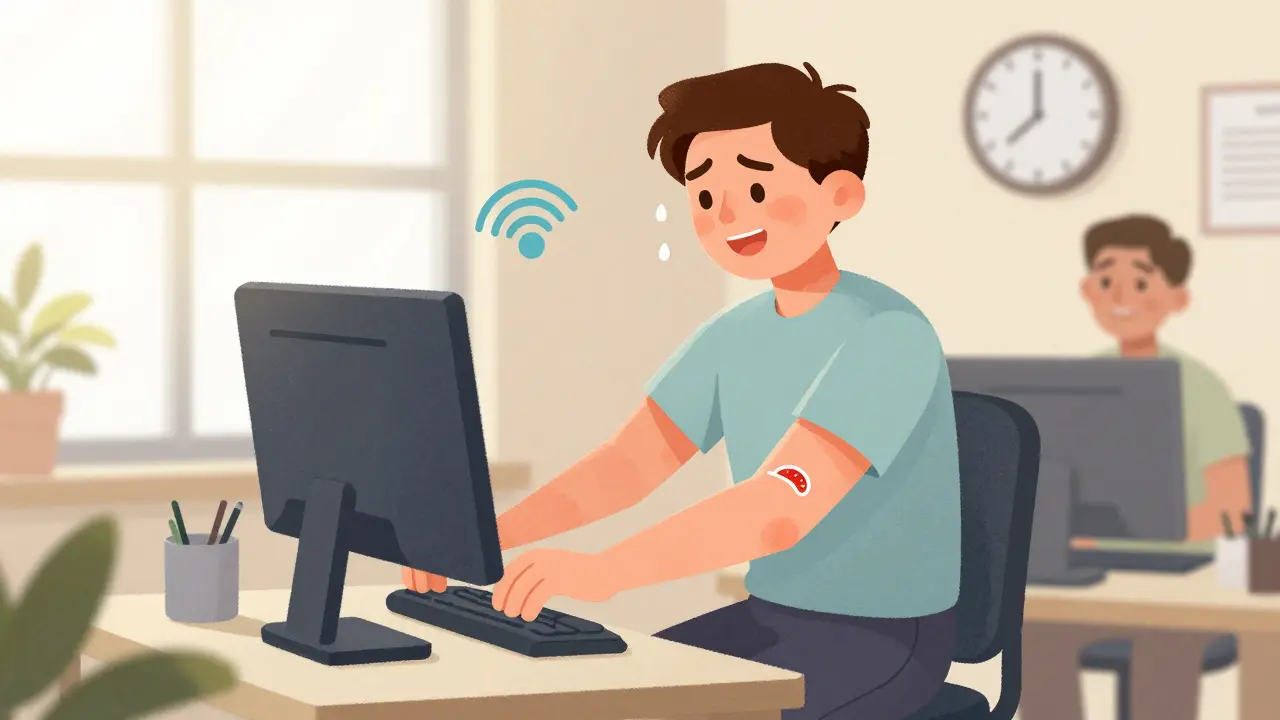
Coming back to work after living with chronic pain isn’t just about showing up-it’s about staying. If your pain has kept you off the job for weeks or months, you’re not alone. Nearly one in five adults in the U.S. deals with chronic pain that affects their ability to work. But returning doesn’t mean suffering through long hours or ignoring your body. With the right accommodations and a clear plan, you can keep your job without sacrificing your health.
What Counts as a Chronic Pain Accommodation?
Chronic pain isn’t just a bad day. It’s pain that lasts longer than three months and makes everyday tasks harder-sitting, standing, lifting, even typing. Under the Americans with Disabilities Act (ADA), this qualifies as a disability if it limits major life activities. That means your employer is legally required to make reasonable changes to help you do your job.Many people think accommodations mean expensive gear or big office overhauls. They don’t. According to the Job Accommodation Network, 56% of accommodations cost nothing. The rest? Most are under $300. Here’s what actually works:
- Ergonomic chairs ($200-$1,000) that support your lower back and reduce pressure on sensitive joints.
- Adjustable standing desks ($300-$1,200) so you can switch between sitting and standing every 30-60 minutes.
- Specialized keyboards or mice ($50-$300) designed to reduce wrist strain-especially helpful for carpal tunnel or arthritis.
- Voice recognition software ($100-$300) to cut down on typing if your hands hurt.
- Footrests ($25-$150) and seating cushions ($50-$200) to relieve pressure on hips, tailbone, or sciatic nerves.
It’s not just hardware. Time-based changes matter just as much:
- Flexible hours-start at 10 a.m. if mornings are stiff, or leave early for physical therapy.
- Extra breaks-5 to 15 minutes every 1-2 hours to stretch, walk, or just rest.
- Telecommuting-working from home even one or two days a week cuts down on commuting stress and fatigue.
- Modified duties-if you can’t lift heavy boxes, can you handle inventory digitally instead?
Your Step-by-Step Return-to-Work Plan
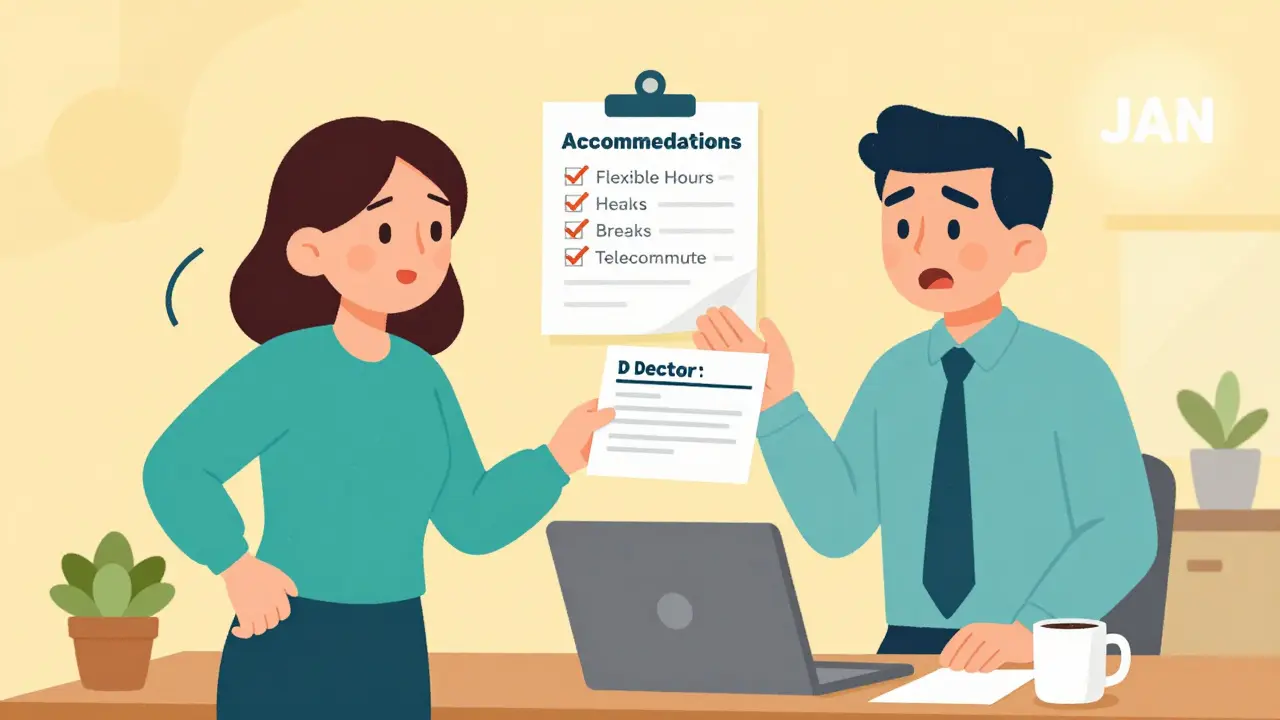
You don’t have to guess what to ask for. A clear plan makes your request harder to ignore.- Get medical documentation. Your doctor or pain specialist needs to write a note that says: “Diagnosis: [e.g., degenerative disc disease]. Functional limitations: difficulty sitting longer than 45 minutes, pain increases with repetitive motion. Recommended accommodations: adjustable desk, 10-minute breaks every 90 minutes.” Vague requests get denied. Be specific.
- Know your rights. If you work for a company with 15+ employees, the ADA applies. In California, even employers with 5+ employees must comply. Federal workers have even stronger protections under the Rehabilitation Act.
- Write your request. Don’t just say, “I need help.” Say: “I’m requesting a sit-stand desk and two 10-minute rest breaks during my 8-hour shift to manage chronic lower back pain. This is recommended by my healthcare provider and aligns with ADA guidelines.” Put it in writing. Email is best.
- Propose solutions, not just problems. Suggest the exact product you need: “A Flexispot E7 standing desk costs $450 and plugs into a standard outlet.” Or: “I’d like to shift my start time from 8 a.m. to 10 a.m. to allow for morning stretching and pain management.”
- Ask for a meeting. Request a conversation with your manager and HR. Bring your doctor’s note and your list. If they hesitate, mention the Job Accommodation Network (JAN)-they offer free, confidential advice to employers too.
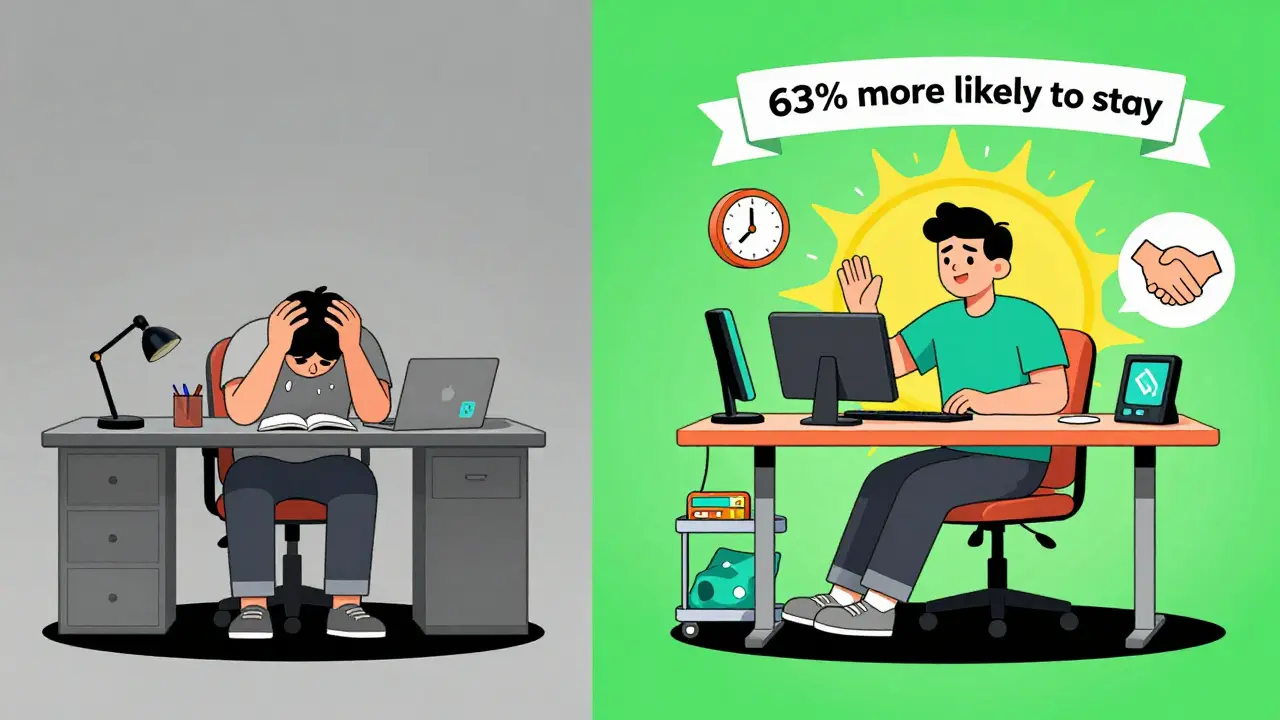
- Start small. If full-time work feels overwhelming, ask for a graduated return: 4 hours a day, 3 days a week, for the first two weeks. Studies show this increases long-term retention by 63% compared to jumping back in full force.
What Employers Can’t Say No To (And What They Can)
Employers can’t refuse accommodations just because they’re inconvenient. But they can say no if it causes “undue hardship”-meaning it’s too expensive or disruptive for their size.Here’s the truth: small businesses have a lower bar for hardship. A $500 desk might be a stretch for a 5-person shop. But for a company with 50+ employees? That’s less than one day’s payroll. Courts and the EEOC look at company size, budget, and resources-not just the price tag.
Also, accommodations don’t have to be perfect. They just have to work. If you ask for a $1,200 ergonomic chair and they offer a $200 cushion that helps, that’s a win. You don’t get to pick the brand-you get to pick a solution that lets you work.
They can’t say no because:
- You didn’t ask perfectly the first time (they must engage in an “interactive process”).
- You’re having a flare-up (accommodations can be temporary).
- You didn’t tell them you had a disability (they can’t assume-you have to ask).
They can say no if:
- The accommodation removes an essential job function (like lifting 50 lbs for a warehouse job).
- It creates a safety risk for you or others.
- The cost would bankrupt the company (rare).
Why Coworkers and Supervisors Matter More Than You Think
You might think this is all about paperwork and policies. But the real key? People.Research shows employees with strong relationships with their managers and coworkers are 2.3 times more likely to get accommodations approved. Why? Because trust matters. If your manager sees you as someone who shows up, does good work, and speaks up respectfully-they’re more likely to help.
On the flip side, 62% of people with chronic pain delay asking for help because they fear being seen as weak, lazy, or a burden. That fear costs jobs. One study found that 31% of people quit rather than disclose their pain.
Here’s how to build that trust:
- Be upfront but professional. “I’ve been managing chronic back pain for a few years. I’m still fully capable of doing my job, and I’d like to talk about small changes that would help me stay on track.”
- Don’t apologize for needing help. Accommodations aren’t favors-they’re rights.
- Thank your manager when they make a change. A simple “I really appreciate the desk adjustment-it’s made a big difference” goes a long way.
What to Do If Your Request Is Denied
If your employer says no, don’t panic. You still have options.First, ask for a written explanation. They must give you one under ADA rules. If they say “it’s too expensive,” ask: “Can we look at lower-cost options?” or “Could we try a 30-day trial?”
If they still refuse, contact the Job Accommodation Network (JAN). They’re free, confidential, and have helped resolve 82% of accommodation issues without formal complaints. They’ll even write a letter to your employer explaining the law.
If that doesn’t work, you can file a complaint with the Equal Employment Opportunity Commission (EEOC). The process takes time, but you’re protected from retaliation. And remember: the EEOC reported a 17% increase in chronic pain-related ADA claims between 2021 and 2022. You’re not alone.
Real-Life Examples That Worked
Case 1: Maria, administrative assistant, 48
Maria had fibromyalgia. Sitting for more than 20 minutes made her legs ache. She asked for a standing desk and 10-minute breaks every 90 minutes. Her company bought a $480 Flexispot desk. She also started working from home one day a week. Result? Her productivity stayed the same. Her pain levels dropped 40%.
Case 2: James, warehouse supervisor, 56
James had degenerative disc disease. He couldn’t walk more than 150 feet without pain. His job required walking the entire warehouse. He asked to be moved to a ground-floor office near the loading dock and given a motorized cart to move paperwork. The cart cost $220. His manager agreed. James stayed on the job for another 5 years.
Case 3: Lena, remote customer service rep, 32
Lena had long COVID with chronic nerve pain. She couldn’t sit for 8 hours straight. She asked for a flexible schedule: 4 hours a day, split into two blocks. She also used voice-to-text software. Her employer agreed. She kept her job and later moved to part-time permanently.
What’s Changing in 2025
The rules are slowly getting better. In 2023, the Department of Labor launched a national “Return to Work Initiative” to help states create standard RTW plans for chronic pain. More employers are starting to see pain as a workplace issue-not just a medical one.Wearable tech is starting to play a role. Some companies now let employees use devices that track movement, heart rate, and rest patterns to show functional limits-making it harder to dismiss “invisible” pain.
And if you have long COVID? The EEOC confirmed in 2021 that it qualifies as a disability under the ADA. That means the same rules apply: accommodations are required.
Frequently Asked Questions
Do I have to tell my employer I have chronic pain?
You don’t have to disclose your diagnosis, but you do need to tell them you have a medical condition that requires workplace changes to do your job. You can say, “I have a medical condition that affects my ability to sit or stand for long periods,” without naming it. But to get legal protection under the ADA, you must request an accommodation, which means you’ll need to explain how your condition impacts your work.
Can my employer fire me for needing accommodations?
No. Under the ADA and Rehabilitation Act, firing someone because they requested a reasonable accommodation is illegal. If you’re let go after asking for help, you may have grounds for a discrimination claim. Keep records of all requests, emails, and responses. The EEOC can help you file a complaint if needed.
What if my job requires physical tasks I can’t do anymore?
Employers must reassign you to another role if you can’t do your current one-even if it’s a lower-level position. This is called “reassignment.” For example, if you’re a retail associate who can no longer stand for hours, you might be moved to a cashier or inventory role. You’re not expected to do tasks that are essential to your job if you physically can’t. But you must be able to do the core functions of another available position.
Can I use FMLA and accommodations at the same time?
Yes. FMLA gives you up to 12 weeks of unpaid, job-protected leave. Accommodations under the ADA let you return to work with changes to your schedule or duties. They’re not the same thing. You can take FMLA leave to recover, then come back with accommodations. Many people use both: leave for flare-ups, accommodations for daily management.
Are there free resources to help me ask for accommodations?
Yes. The Job Accommodation Network (JAN) offers free, confidential advice for employees and employers. They provide templates for accommodation requests, sample doctor’s note language, and even call employers to explain the law. You can reach them at askjan.org or by phone. They’ve helped resolve over 80% of cases without legal action.
Next Steps: What to Do Today
Don’t wait for the pain to get worse. Start now:
- Write down your top three work limitations (e.g., “I can’t sit longer than 30 minutes,” “I need to walk slowly,” “My hands hurt when typing”).
- Ask your doctor for a one-page note listing your diagnosis, limitations, and recommended accommodations.
- Look up your company’s HR policy on disability accommodations. Most have a form or process.
- Visit JAN’s website and download their “Chronic Pain Accommodation Ideas” guide. Use it to build your request.
- Send your employer an email. Keep it simple, professional, and solution-focused.
You don’t have to choose between your health and your job. With the right plan, you can do both.




Michael Dillon
December 25, 2025 AT 12:51Mussin Machhour
December 26, 2025 AT 06:38sagar patel
December 27, 2025 AT 08:16Zabihullah Saleh
December 28, 2025 AT 21:30Rick Kimberly
December 30, 2025 AT 19:03Harbans Singh
January 1, 2026 AT 02:46Katherine Blumhardt
January 2, 2026 AT 02:08Ben Harris
January 2, 2026 AT 09:43Winni Victor
January 3, 2026 AT 17:59Carlos Narvaez
January 5, 2026 AT 14:54Bailey Adkison
January 6, 2026 AT 05:37Terry Free
January 7, 2026 AT 16:42Sophie Stallkind
January 9, 2026 AT 11:15Gary Hartung
January 11, 2026 AT 05:11Lindsay Hensel
January 11, 2026 AT 10:21