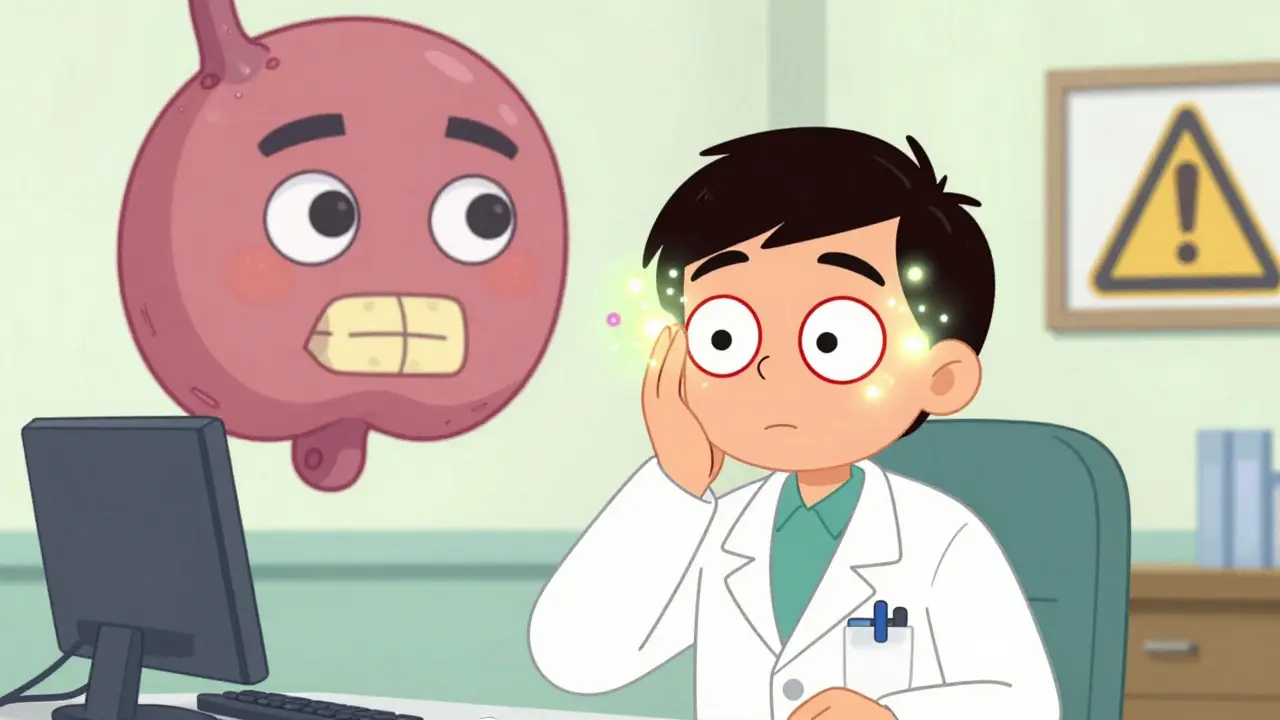
Thyroid Eye Disease (TED), also called Graves’ ophthalmopathy, isn’t just about thyroid problems-it’s an autoimmune attack on the tissues behind your eyes. It causes swelling, bulging, double vision, and sometimes vision loss. About 50% of people with Graves’ disease develop it, but even those with normal thyroid levels can get it. Women are four to six times more likely than men, and smoking raises your risk by nearly eight times. If you’ve noticed your eyes feeling gritty, looking bulging, or seeing double, this could be why.
What Does Thyroid Eye Disease Actually Do?
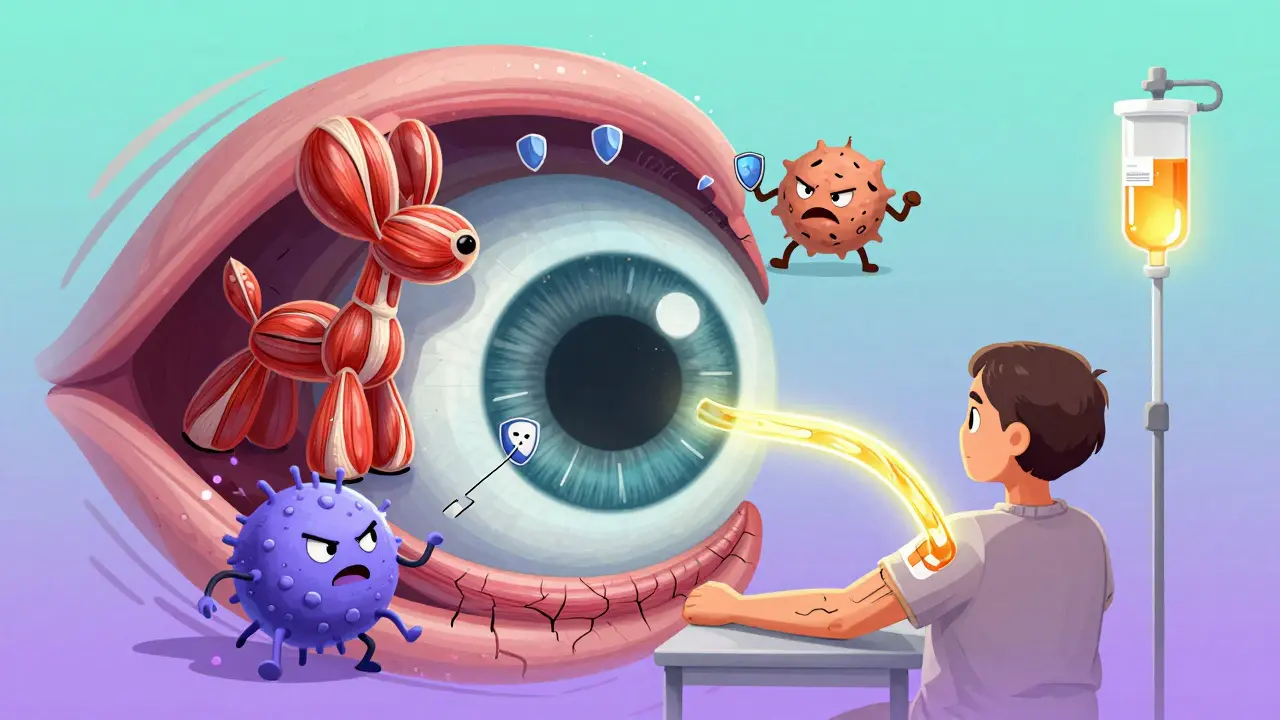
Inside your eye socket, there’s fat and muscle that helps your eyeball move. In TED, your immune system mistakes these tissues for threats and starts attacking them. This triggers inflammation, fluid buildup, and scarring. The result? Your eyes push forward, eyelids swell, and muscles stiffen-making it hard to look up, down, or side to side.
Symptoms vary. Some people just feel dry, irritated eyes. Others have severe pain, redness, or even vision loss. Common signs include:
- Gritty or burning sensation (78% of patients)
- Red, puffy eyelids (44%)
- Light sensitivity (65%)
- Pain when moving the eyes (52%)
- Bulging eyes (proptosis, 31% severe)
- Double vision (diplopia, 28%)
- Excessive tearing or dryness
Most cases affect both eyes, but 11% start in just one. The condition has two phases: active (inflammatory) and inactive (fibrotic). The active phase lasts 6 to 24 months. During this time, inflammation is high, and treatment can stop damage. Once it’s inactive, scarring sets in-and that’s when surgery might be needed.
How Is It Measured and Diagnosed?
Doctors use the Clinical Activity Score (CAS) to check if TED is still active. A score of 3 or higher means inflammation is ongoing. They’ll also look at eye movement, swelling, and vision changes. Imaging like CT or MRI scans show which eye muscles are swollen. The inferior rectus muscle is affected in 85% of cases, followed by the medial rectus.
High levels of TSH receptor antibodies (TRAb) are a red flag. If your TRAb is over 15 IU/L, your risk of developing TED jumps nearly fivefold. That’s why doctors test for it in all Graves’ patients. Smoking, age (40-60), female gender, and radioactive iodine treatment without steroids all increase risk.
Steroids: The Traditional Treatment
For moderate-to-severe TED in the active phase, steroids are still the go-to. But not all steroids are the same.
Intravenous (IV) methylprednisolone is the gold standard. A typical course: 500 mg once a week for six weeks, then 250 mg for another six weeks. About 60-70% of patients see improvement in swelling, redness, and double vision. It’s more effective than oral steroids and has fewer side effects when given this way.
Oral prednisone (0.4-0.8 mg per kg of body weight daily) is used for milder cases. But it’s risky. About 25-30% of patients relapse after stopping it. Side effects are common: weight gain (average 8.2 kg), high blood sugar (18% develop prediabetes), bone thinning, and mood swings. Doctors limit total IV steroid doses to 4.5-5.0 grams to avoid liver damage, which happens in about 2.3% of higher-dose cases.
For mild TED, artificial tears and selenium supplements (200 mcg daily) help. A Cochrane review found selenium improves quality of life by 23% compared to placebo-though the effect is modest. It’s cheap, safe, and worth trying if your symptoms are just starting.
Biologics: The Game-Changer
Enter teprotumumab (Tepezza®). Approved by the FDA in 2020, it’s the first treatment that targets the root cause of TED-not just suppressing inflammation, but blocking the signal that triggers it.
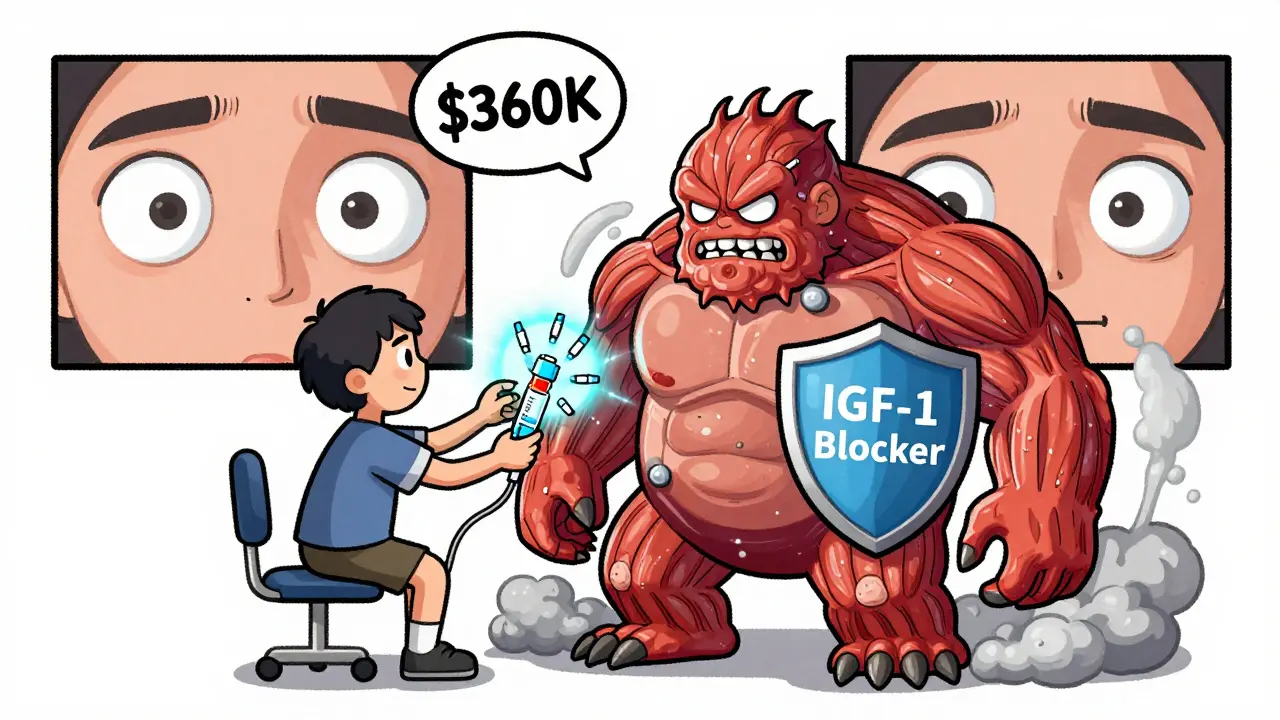
Teprotumumab is a monoclonal antibody that blocks the IGF-1 receptor, which is overactive in TED eye tissue. In the OPTIC trial, 71% of patients had at least 2 mm of eye bulging reduction, compared to just 20% on placebo. Double vision improved in 59% of those on teprotumumab versus 26% on placebo. The treatment is eight infusions over 22 weeks: 10 mg/kg first, then 20 mg/kg every three weeks.
Patients report life-changing results. One Reddit user saw their proptosis drop from 24mm to 20mm after eight infusions. But it’s expensive-around $360,000 per course in the U.S. Insurance often denies coverage, and 42% of patients face delays of 47 days or more for approval. Medicaid patients are especially affected: 67% face barriers, versus 28% with private insurance.
Side effects happen. Muscle spasms (24%), hearing changes (11%), and high blood sugar (8%) are common. The FDA added a boxed warning in 2021 for these risks. Still, patient satisfaction is higher than with steroids: 74% vs. 58% in Cleveland Clinic’s survey.
What About Other Biologics?
Teprotumumab isn’t the only option on the horizon. Satralizumab (Enspryng®), an anti-IL-6 antibody, got FDA approval in 2023 for steroid-resistant TED. It’s given as a monthly shot under the skin, not an IV infusion. Early data shows a 54% response rate in reducing eye bulging.
Rituximab (targets B cells) and tocilizumab (blocks IL-6) are being studied too. But evidence is still limited. Teprotumumab remains the best-supported option.
By 2025, a biosimilar version is expected to cut costs by 30-40%. That could make it accessible to more people. Meanwhile, the TOPAZ trial is testing whether adding selenium to teprotumumab boosts results-early data shows an 82% response rate, higher than teprotumumab alone.
When Is Surgery Needed?
Surgery is not the first step. It’s reserved for the inactive phase, when inflammation has settled and damage is permanent.
Orbital decompression removes bone from the eye socket to create space, reducing bulging by 2-5 mm. It helps with appearance and protects the optic nerve. But it carries risks: 15% get new or worse double vision, 8% get sinus infections, and 0.5% risk vision loss.
Strabismus surgery fixes misaligned eyes caused by stiffened muscles. Prisms in glasses help 60% of people with double vision-but only if muscle movement isn’t too stiff. If the misalignment exceeds 15 prism diopters, surgery is needed.
Lid surgery corrects retracted eyelids that won’t close properly. This prevents corneal damage and improves appearance.
What’s Next for TED Treatment?
The TED market is exploding. It was worth $1.2 billion in 2023 and could hit $4.7 billion by 2030. Tepezza alone brought in $2.1 billion in sales in 2022. But access isn’t equal. Only 45% of ophthalmologists now routinely use biologics-down from 12% in 2020. In rural areas, just 28% have access to specialized TED centers.
Experts agree: early treatment saves vision. If you’re diagnosed with Graves’ disease and have even mild eye symptoms, don’t wait. Get a CAS score. Test your TRAb. Talk to an endocrinologist and ophthalmologist together. The goal isn’t just to feel better-it’s to avoid surgery later.
Research is moving fast. Scientists are hunting for genetic markers that predict who will get TED and who will respond to which treatment. Within five years, we may be able to personalize therapy before symptoms even start.
Key Takeaways
- Thyroid Eye Disease affects up to half of Graves’ patients, even those with normal thyroid levels.
- Smoking is the biggest modifiable risk-quit if you smoke.
- IV steroids are effective for active TED, but have serious side effects.
- Teprotumumab (Tepezza®) is the first targeted therapy, with strong evidence for reducing bulging and double vision.
- Surgery is last-resort and only done after inflammation stops.
- Access to biologics is limited by cost and insurance-patients often face delays or denials.
Can thyroid eye disease go away on its own?
Yes, but not always safely. TED has two phases: active and inactive. In the active phase, inflammation can cause permanent damage to muscles, nerves, or the cornea. If left untreated, this can lead to lasting vision problems, double vision, or eye bulging. While some mild cases stabilize without treatment, waiting too long increases the chance you’ll need surgery later. Early intervention with steroids or biologics during the active phase is critical to prevent irreversible damage.
Is steroid treatment for TED safe?
IV steroids are generally safer than oral steroids for TED. Oral prednisone can cause weight gain, high blood sugar, mood swings, and bone loss, with a 25-30% relapse rate. IV methylprednisolone has fewer side effects and higher success rates-60-70% of patients improve. But even IV steroids carry risks: liver toxicity (2.3% at high doses), temporary high blood pressure, and insomnia. The European Group on Graves’ Orbitopathy recommends limiting total IV dose to 4.5-5.0 grams to reduce liver damage risk. Still, for moderate-to-severe TED, the benefits usually outweigh the risks.
Why is teprotumumab so expensive?
Teprotumumab (Tepezza®) is expensive because it’s a highly specialized biologic drug developed for a rare condition. Only about 16 in 100,000 people get TED each year, so the market is small. Development costs are high, and Horizon Therapeutics (now owned by Amgen) priced it at around $360,000 per course. Insurance often denies coverage, and prior authorization can take over 47 days. Medicaid patients face even higher denial rates-67% compared to 28% for private insurance. A biosimilar version is expected by 2025 and could cut costs by 30-40%.
Does selenium really help with thyroid eye disease?
Yes-but only for mild cases. A 2020 Cochrane review found that 200 mcg of selenium daily improved quality of life scores by 23% compared to placebo in patients with mild TED. It reduces swelling and discomfort over 6 months. It doesn’t fix bulging or double vision, and it has no effect on moderate-to-severe disease. It’s safe, inexpensive, and recommended by the American Thyroid Association for mild cases. But it’s not a substitute for steroids or biologics when inflammation is active.
Can I still get TED if my thyroid levels are normal?
Absolutely. While most TED cases occur with Graves’ disease (overactive thyroid), about 10-15% of patients have normal thyroid function (euthyroid) or even an underactive thyroid (hypothyroid). TED is driven by autoantibodies that target eye tissue, not thyroid hormone levels. So even if your TSH, T3, and T4 are normal, you can still have inflammation behind your eyes. If you have eye symptoms and a history of thyroid issues, get tested for TRAb antibodies-it’s the best predictor of TED risk.

Tommy Chapman
February 20, 2026 AT 21:32Let me get this straight-people are paying $360K for a drug that just reduces eye bulging by a few millimeters? And we wonder why healthcare is broken. In my day, we just used ice packs and told people to stop being dramatic. This is capitalism at its finest: turn a rare autoimmune condition into a luxury product for the rich. Meanwhile, my cousin in Ohio can’t afford insulin. Wake up, people.
Robin bremer
February 21, 2026 AT 21:31Hariom Sharma
February 23, 2026 AT 06:55From India, I just want to say-this is why global health equity matters. In Delhi, most people can’t even access basic eye care, let alone $360K biologics. But here’s the thing: selenium is cheap, safe, and works for mild cases. Why aren’t we pushing that harder in low-resource settings? Simple solutions shouldn’t be overshadowed by fancy drugs. Let’s not forget: healing starts with access, not just innovation.
Nina Catherine
February 25, 2026 AT 04:28Okay but can we talk about how wild it is that smoking increases risk by 8x?? I mean, I get it, smoking is bad, but this is like the universe slapping you in the face with a giant ‘I told you so’ sign. I quit last year after my mom got diagnosed, and honestly? Best decision ever. Not just for TED, but for everything. Your eyes are worth more than a cigarette.
Taylor Mead
February 25, 2026 AT 12:48I’m an endo tech and I’ve seen this play out. Steroids work, but they’re a band-aid. Teprotumumab? It’s a reset button. The problem isn’t the drug-it’s the insurance maze. I’ve had patients wait 6 months just to get approval. Meanwhile, their vision keeps deteriorating. We need a system that prioritizes outcomes over paperwork. Also-selenium isn’t magic, but it’s the only thing some folks can get. Don’t dismiss it.
Amrit N
February 25, 2026 AT 15:37Chris Beeley
February 26, 2026 AT 16:34Let me offer some perspective from the global elite-this isn’t just about medicine, it’s about the philosophical collapse of Western healthcare. We have commodified suffering. Teprotumumab isn’t a treatment-it’s a symptom of a civilization that values profit over presence. The fact that Medicaid patients face 67% denial rates isn’t a policy failure-it’s a moral indictment. We have the science to cure blindness, yet we let bureaucracy decide who sees. The real TED isn’t in the orbit- it’s in the soul of our system.
Arshdeep Singh
February 27, 2026 AT 10:51Listen, I’ve read every paper on this. Teprotumumab’s mechanism? Brilliant. But let’s not pretend it’s the end-all. The IGF-1 receptor isn’t the only pathway. You think they didn’t try blocking TNF-alpha first? Of course they did. Failed trials. But no one talks about that. Why? Because the narrative sells better: ‘miracle drug’ beats ‘another failed trial.’ Real science is messy. And if you’re waiting for a biosimilar in 2025? You’re already behind. Start with selenium. Then steroids. Then-only then-consider the $360K option. Don’t be a sheep.
Maddi Barnes
March 1, 2026 AT 10:35Oh honey, you think $360K is bad? Try getting diagnosed in rural Alabama with no endocrinologist within 200 miles. 😒 I’ve had patients cry because their insurance said ‘Tepezza is experimental’-it’s been FDA-approved since 2020. Meanwhile, my neighbor’s dog has better healthcare. And don’t even get me started on how the pharmaceutical industry turns rare diseases into gold mines. We need price caps. Now. Not later. Not ‘when the biosimilar comes.’ NOW.
Benjamin Fox
March 2, 2026 AT 09:47