Anticoagulation Safety Estimator for Kidney Disease
Enter patient parameters and click "Analyze Options" to see anticoagulation recommendations based on current clinical guidelines.
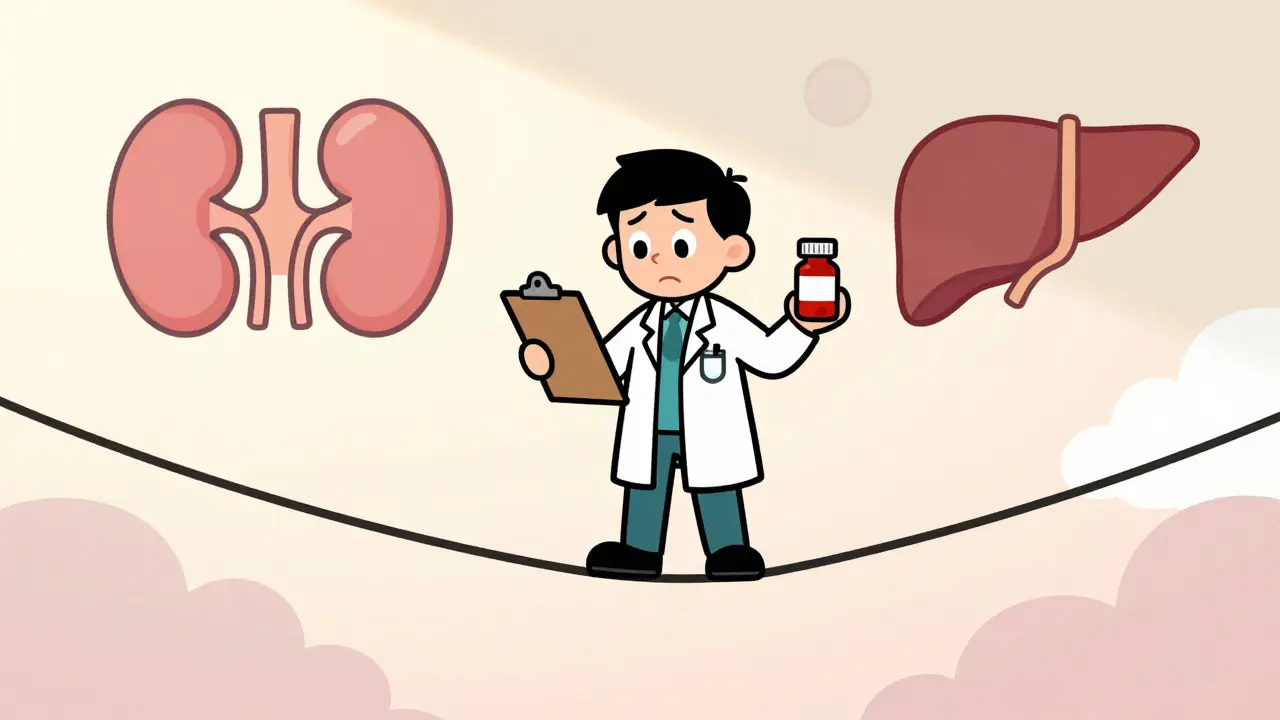
Imagine trying to walk a tightrope while blindfolded. That is essentially what managing anticoagulation looks like for patients with both kidney and liver disease. You are trying to prevent a life-threatening clot, but every step risks a catastrophic bleed. For millions of people living with chronic organ impairment, this isn't just a medical theory-it is a daily reality. The standard advice often fails here because the organs responsible for clearing these drugs from your body are the very ones that are failing.
The landscape changed dramatically after 2010 when direct oral anticoagulants (DOACs) entered the market. While they revolutionized stroke prevention for healthy hearts, they left a massive gap in knowledge for those with advanced organ dysfunction. Major trials like ARISTOTLE and RE-LY systematically excluded patients with severe kidney or liver issues. Today, we are navigating this gray area with observational data, pharmacokinetic studies, and expert consensus rather than definitive randomized controlled trial evidence.
Understanding the Dual Organ Challenge
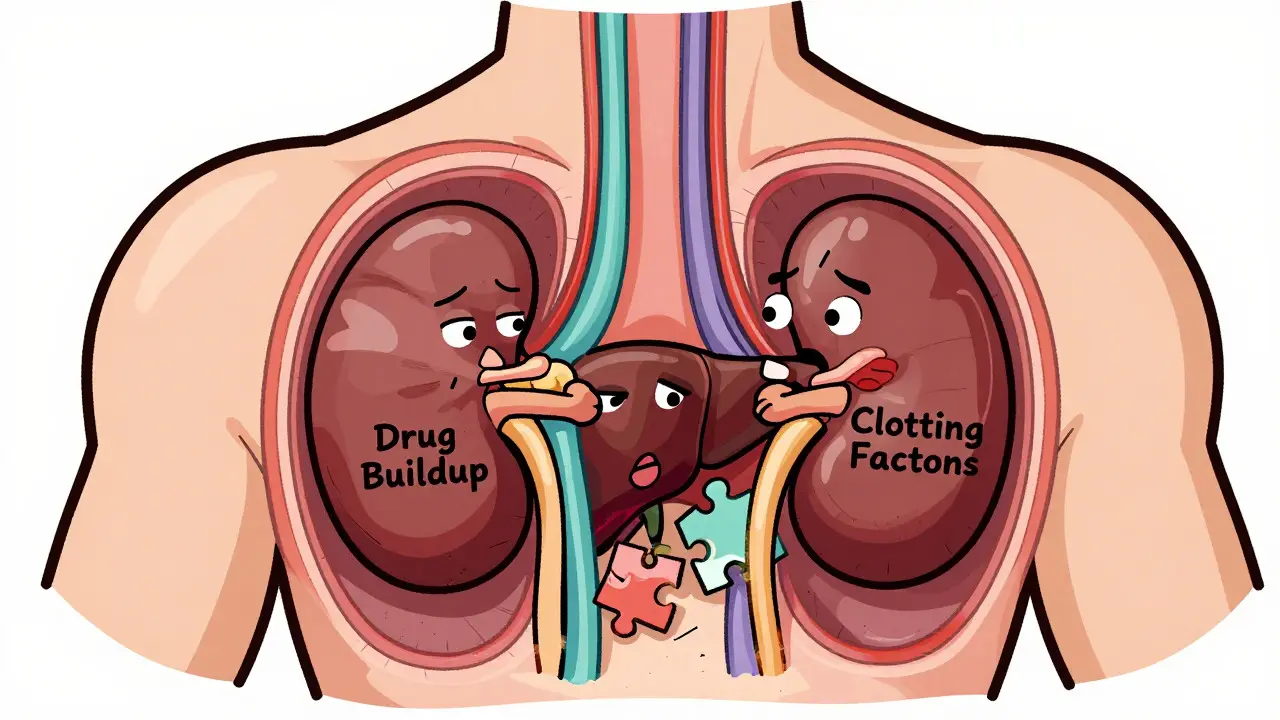
To make sense of the options, you first need to understand why kidney and liver disease complicate things so much. These two organs work together to maintain your body's balance. When one fails, the other often struggles too, creating a vicious cycle known as hepatorenal syndrome.
In kidney disease, the primary issue is clearance. Most blood thinners leave the body through urine. If your kidneys aren't filtering properly, the drug builds up in your system, increasing bleeding risk. In liver disease, the problem is synthesis and metabolism. Your liver produces the proteins that help blood clot (like factors II, VII, IX, and X) and the proteins that stop clotting (like protein C and S). When the liver is damaged, it makes less of both, leading to a fragile state called 'rebalanced hemostasis.' Add in low platelet counts from an enlarged spleen, and you have a perfect storm for unpredictable bleeding.
| Organ | Primary Function in Drug Metabolism | Risk if Impaired |
|---|---|---|
| Kidney | Clearance of drug metabolites via urine | Drug accumulation, increased bleeding risk |
| Liver | Synthesis of clotting factors and drug metabolism | Unpredictable INR, reduced efficacy, spontaneous bleeding |
Navigating Kidney Disease Stages
Not all kidney disease is created equal. The approach depends heavily on your estimated glomerular filtration rate (eGFR), which measures how well your kidneys filter waste. However, be aware that creatinine-based equations can be imprecise in advanced stages, sometimes missing the true extent of kidney function by 30-40%.
Stages 1-3a (eGFR ≥45 mL/min): This is the safest zone. You can generally use all DOACs at standard doses. Apixaban, rivaroxaban, dabigatran, and edoxaban are all viable options here, guided by your stroke risk score (CHA2DS2-VASc).
Stage 3b (eGFR 30-44 mL/min): Caution enters the picture. Dose adjustments become necessary. For example, rivaroxaban typically drops from 20 mg to 15 mg daily, and apixaban may reduce to 2.5 mg twice daily depending on other risk factors. Edoxaban also requires reduction from 60 mg to 30 mg.
Stages 4-5 (eGFR <30 mL/min): This is where guidelines diverge sharply. The European Medicines Agency contraindicates rivaroxaban and apixaban entirely. However, the FDA allows apixaban at 2.5 mg twice daily based on post-hoc analyses showing it significantly reduces major bleeding compared to warfarin in this group. Dabigatran is largely avoided due to its high renal clearance (80%), making it risky when kidney function is minimal.
Hemodialysis Patients: This remains one of the most debated areas. Pharmacokinetic studies show that apixaban 2.5 mg twice daily achieves therapeutic trough levels similar to those seen in patients with normal kidney function, albeit lower. Warfarin is still widely used, but it requires more frequent monitoring-often biweekly instead of monthly-because kidney patients are more sensitive to its effects. Some experts suggest lowering the target INR range to 1.8-2.5 to minimize bleeding without sacrificing protection against clots.
Managing Liver Disease Complexity
Liver disease introduces a different set of hurdles. The severity is usually classified using the Child-Pugh score, which assesses bilirubin, albumin, INR, ascites, and encephalopathy.
Child-Pugh Class A (Score 5-6): Mild impairment. DOACs are generally considered safe with standard dosing. The liver can still metabolize these drugs effectively enough to maintain steady levels.
Child-Pugh Class B (Score 7-9): Moderate impairment. Here, caution is key. You might consider dose reductions or closer monitoring. Apixaban is often preferred over rivaroxaban because it has less hepatic metabolism dependency. However, there is no universal agreement on exact dosing, so individual assessment is critical.
Child-Pugh Class C (Score ≥10): Severe impairment. Most guidelines recommend avoiding DOACs entirely. The bleeding risk skyrockets-some studies show a 5.2-fold increase in major bleeding events. In these cases, warfarin might be considered, but even then, the INR becomes an unreliable metric. Why? Because INR only measures vitamin K-dependent factors, ignoring the broader coagulation chaos happening in your body. Advanced testing like thromboelastography (TEG) provides a better picture, but access is limited; only about 38% of community hospitals in the US offer it.
Warfarin vs. DOACs: Making the Choice
The choice between traditional warfarin and newer DOACs isn't just about convenience; it's about safety profiles in specific contexts.
In moderate kidney disease (Stage 3-4), apixaban shows a clear advantage. Subgroup analyses indicate a 31% lower risk of major bleeding compared to warfarin. It also drastically reduces intracranial hemorrhage-a feared complication in elderly patients. However, in end-stage renal disease (ESRD), the benefit narrows. Warfarin remains the go-to for mechanical heart valves, where DOACs are not approved.
In liver disease, warfarin has theoretical advantages because its effect can be reversed with vitamin K or fresh frozen plasma. But practically, maintaining a stable INR in cirrhosis is notoriously difficult. Only 45% of cirrhotic patients spend more than 60% of their time in the therapeutic range, compared to 65% in non-cirrhotic patients. This instability increases the risk of both strokes and bleeds. Conversely, DOACs offer predictable pharmacokinetics in mild-to-moderate liver disease but lack reversal agents that are widely available. Andexanet alfa exists for factor Xa inhibitors but costs around $19,000 per dose and is only available in half of US hospitals.

Practical Steps for Safe Management
If you or a loved one fall into these categories, proactive management is essential. Here is a checklist to discuss with your care team:
- Regular Monitoring: Check eGFR every 3 months for kidney patients, or monthly if declining rapidly. For liver patients, monitor platelet counts and MELD scores monthly.
- Multidisciplinary Care: Ensure your nephrologist, cardiologist, and hepatologist are communicating. Discrepancies in opinion are common, so a unified plan prevents medication errors.
- Bleeding Precautions: Use soft-bristle toothbrushes, electric razors, and avoid high-impact sports. Report any unusual bruising or dark stools immediately.
- Medication Review: Avoid NSAIDs (like ibuprofen) and certain antibiotics that interact with blood thinners. Always check with your pharmacist before starting new supplements.
- Reversal Plan: Know where your nearest hospital with reversal agents is located. Carry a medical alert card stating your anticoagulant name and dose.
Discontinuation thresholds matter too. Many protocols suggest stopping anticoagulation if platelets drop below 50,000/μL or if the MELD score exceeds 20, as the bleeding risk outweighs the clotting benefit.
Future Directions and Current Trials
We are not standing still. Several large-scale studies aim to fill the evidence gaps. The MYD88 trial is currently randomizing hemodialysis patients to compare apixaban against warfarin, with results expected soon. Similarly, the LIVER-DOAC registry is tracking outcomes in cirrhotic patients worldwide. Regulatory bodies like the FDA are reviewing draft guidance that could expand apixaban labeling for ESRD patients based on new pharmacokinetic modeling.
Until then, the mantra remains: treat the patient, not just the lab values. Every case is unique, requiring a delicate balance of science and clinical judgment.
Can I take apixaban if my eGFR is below 15?
Yes, under specific conditions. The FDA permits apixaban 2.5 mg twice daily for patients with end-stage renal disease (ESRD) on dialysis, based on data showing reduced bleeding risk compared to warfarin. However, the European Medicines Agency contraindicates it. Always consult your nephrologist for a personalized decision.
Is warfarin safer than DOACs for liver cirrhosis?
It depends on the severity. In Child-Pugh Class C (severe cirrhosis), warfarin is often preferred because DOACs are contraindicated due to high bleeding risks. However, warfarin is hard to manage in cirrhosis because INR levels are unreliable. Advanced testing like TEG may be needed to guide therapy.
How often should I check my kidney function while on blood thinners?
If you have stable chronic kidney disease, check your eGFR every 3 months. If your kidney function is declining rapidly (more than 5 mL/min/year), you should monitor it monthly. Frequent monitoring helps adjust doses before toxicity occurs.
What happens if I bleed while on a DOAC with kidney failure?
Immediate medical attention is required. Specific reversal agents exist: idarucizumab for dabigatran and andexanet alfa for apixaban/rivaroxaban. However, availability varies by hospital. Supportive care with transfusions and dialysis (for some drugs) may also be used to clear the medication.
Are there natural supplements safe to take with anticoagulants?
Most supplements carry interaction risks. Vitamin K affects warfarin stability. Garlic, ginkgo, and fish oil can increase bleeding risk with any anticoagulant. Always verify with your pharmacist before adding any supplement to your regimen, especially with compromised liver or kidney function.