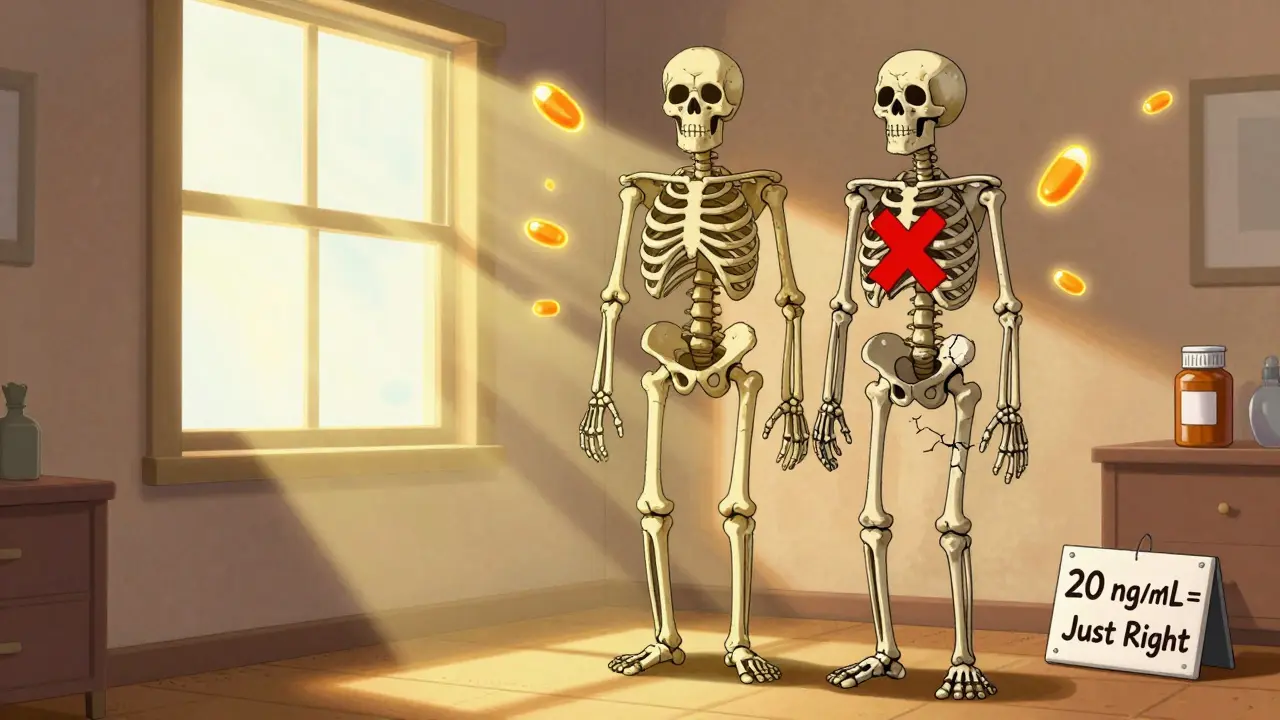
For decades, doctors told us: take vitamin D to keep your bones strong. But recent science is turning that advice upside down. If you’re taking high-dose vitamin D pills hoping to prevent fractures or boost bone density, you might be doing more harm than good. The truth? Vitamin D matters-but only if you’re actually deficient. For most healthy adults, especially those getting sunlight and eating well, extra supplements don’t help bones-and may even weaken them.
How Vitamin D Actually Works for Bones
Vitamin D isn’t just a supplement; it’s a hormone your body makes from sunlight. Its main job? Help your gut absorb calcium. Without enough vitamin D, your body absorbs only 10-15% of the calcium you eat. With enough, that jumps to 60-80%. That’s critical because calcium is the building block of bone. But vitamin D also keeps bones from crumbling by helping them renew properly and by strengthening muscles to prevent falls. That’s why it’s linked to fewer fractures-not just because bones are denser, but because you’re less likely to trip and break a hip.
There are two forms: D2 (from plants) and D3 (from animals and skin). D3 is far more effective. Studies show it raises blood levels of vitamin D 87% more than D2. That’s why most reputable supplements use D3. But here’s the catch: more isn’t always better.
The Numbers: What’s Deficient, Insufficient, or Enough?
The old standard said you needed at least 30 ng/mL (75 nmol/L) of 25-hydroxyvitamin D in your blood to be "sufficient." That’s what the Endocrine Society pushed for years. But large, well-designed studies are now challenging that.
The VITAL trial, led by Harvard Medical School, tracked over 25,000 people for five years. Those taking 2,000 IU daily had no fewer fractures than those taking placebo. Even among people with low baseline levels, the benefit was tiny-barely noticeable. Meanwhile, a 2020 JAMA study found that people taking 4,000 IU or 10,000 IU daily had lower bone density than those taking 400 IU. At the highest dose, radial bone density dropped by 3.9% over three years. That’s not a fluke. It’s a pattern.
So what’s the real target? Experts now think 20 ng/mL (50 nmol/L) may be enough for bone health. Below that? Deficient. Between 20-29 ng/mL? Insufficient. Above 30? Likely fine-but not necessarily better.
Who Actually Needs Supplements?
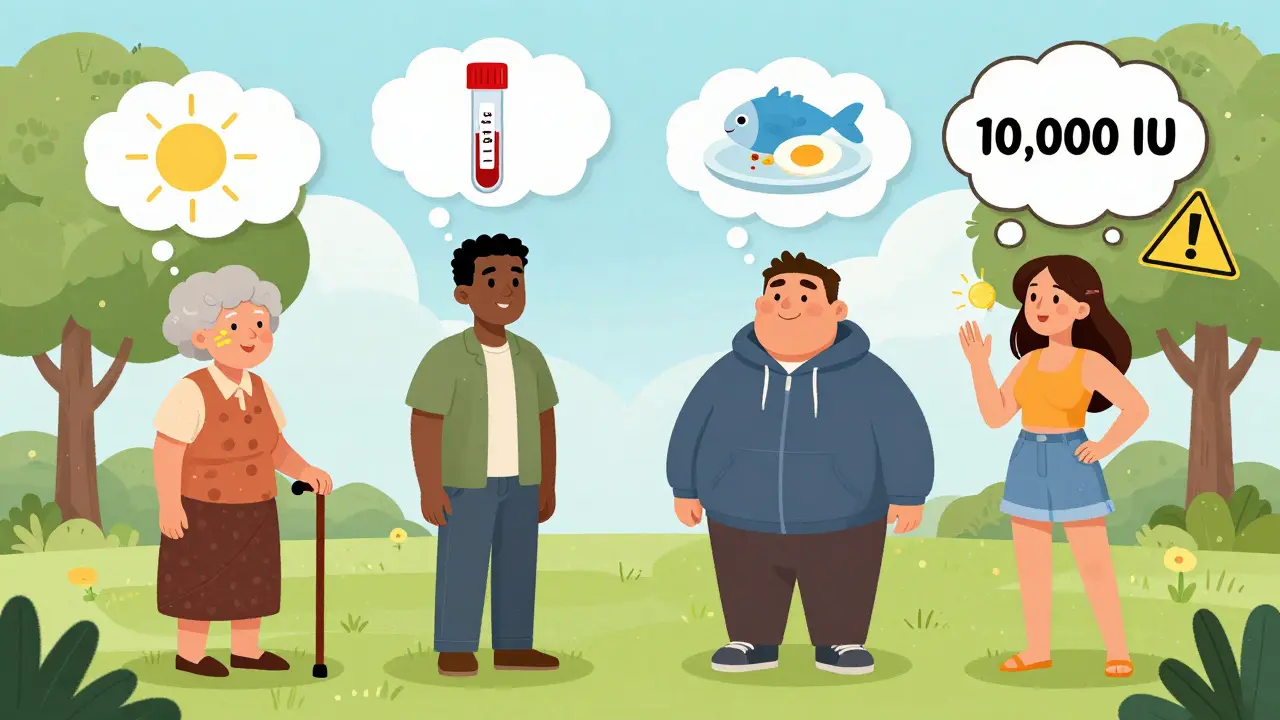
Not everyone. If you’re a healthy adult living in Auckland, getting outside a few times a week in summer, eating fatty fish, or drinking fortified milk-you’re probably fine. But some groups are at real risk:
- People with dark skin living in northern latitudes (less UV exposure)
- Those over 65 (skin makes less vitamin D with age)
- People with obesity (BMI ≥30)-fat traps vitamin D, lowering blood levels by up to 57%
- Anyone with malabsorption issues (Crohn’s, celiac, gastric bypass)
- Those who never go outside or always wear sunscreen
For these people, a blood test is worth it. If your 25(OH)D is below 20 ng/mL, supplementation makes sense. If it’s above 30? You likely don’t need more.
Supplements: Dose, Timing, and Quality
If you need to supplement, here’s how to do it right.
Dose: The Institute of Medicine recommends 600 IU/day for adults under 70, 800 IU/day for those over 70. The Endocrine Society says 1,500-2,000 IU for people with deficiency. But here’s the twist: a 2023 meta-analysis in Nutrients found that calcium + vitamin D only reduced hip fractures when vitamin D was under 400 IU/day. At higher doses? No benefit. And some studies show bone loss.
Timing: Take it with your biggest meal. Vitamin D is fat-soluble. A 2015 study showed absorption jumped 56.7% when taken with dinner versus on an empty stomach. Don’t take it with breakfast if your biggest meal is at night.
Quality: ConsumerLab.com tested 20+ supplements in 2022. Shockingly, 15% contained less than 90% of the labeled dose. One brand had only 72% of its claimed 5,000 IU. Another, Garden of Life, had 128%. Stick to brands that test third-party (like USP, NSF, or ConsumerLab certified). Avoid unregulated online sellers.
Calcium + Vitamin D: The Right Pair
Vitamin D helps you absorb calcium. But if you take calcium without enough vitamin D? It just passes through. And if you take too much calcium without monitoring vitamin D? You risk kidney stones and arterial calcification.
The best combo? 600-800 IU of vitamin D with 1,000-1,200 mg of calcium daily. That’s what the National Osteoporosis Foundation recommends. But here’s the kicker: the benefit of this combo is strongest in people with low baseline vitamin D. In people who already have enough? No extra protection.
One user on HealthUnlocked switched from Citracal + D (a tablet) to liquid D3 drops. Their constipation vanished. That’s common. High-dose calcium supplements can cause digestive issues. Liquid forms or food-based calcium (like sardines or kale) are gentler.
What About High-Dose Claims?
You’ve seen ads: "5,000 IU for stronger bones!" "10,000 IU for total health!"
Don’t believe them.
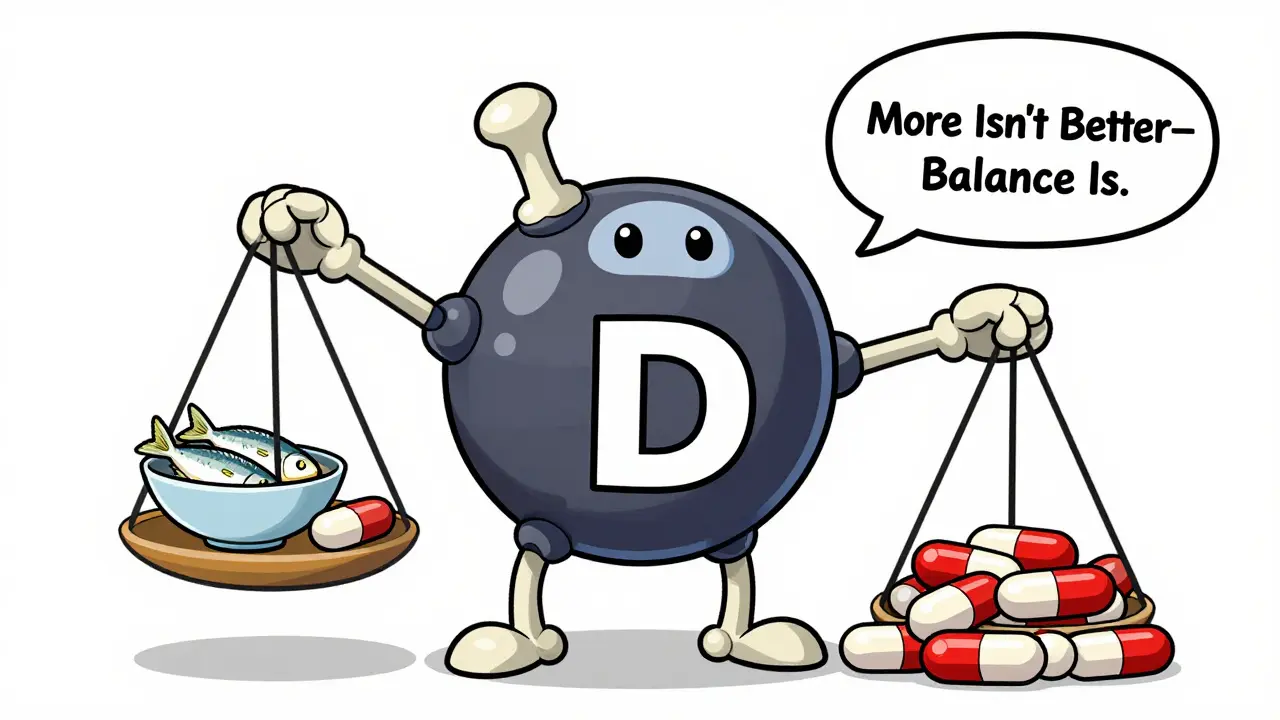
One Reddit user, "BoneHealthWarrior," claimed a 2.1% bone density boost after going from 1,000 IU to 5,000 IU. But that’s anecdotal. Another, "FractureFear," saw their femoral neck density drop 3.7% after two years of 10,000 IU daily. That matches the science: high daily doses can suppress bone formation. The body doesn’t store vitamin D like a battery. It regulates it tightly. Too much can backfire.
The VITAL trial’s lead researcher, Dr. Meryl LeBoff, put it bluntly: "Healthy older adults who take 2,000 IU daily have no fewer fractures than those who take nothing."
What’s Changing in 2026?
Guidelines are shifting fast. The U.S. Preventive Services Task Force (USPSTF) says: don’t take vitamin D to prevent fractures in healthy adults. Grade D recommendation-meaning no benefit outweighs the risk.
Meanwhile, the American Geriatrics Society reported a 22% drop in high-dose prescriptions between 2020 and 2023. Doctors are finally listening to the data.
New research is pointing toward personalized dosing. The 2023 NIH consensus says: test before you supplement. Tailor dose to BMI, baseline levels, and genetics. Some people metabolize vitamin D slowly. Others clear it fast. Future tests may check for genetic variants (like CYP2R1 or GC) that affect how your body uses it.
And there’s emerging hope: eldecalcitol, a synthetic vitamin D analog approved in Japan, reduced vertebral fractures by 37% in a 2022 Lancet study. But it’s not available outside clinical trials. For now, stick to natural D3.
Real-World Advice: What Should You Do?
Here’s your simple action plan:
- Get your 25(OH)D level tested if you’re over 50, have dark skin, are obese, or rarely go outside.
- If your level is below 20 ng/mL: take 1,000-2,000 IU of D3 daily with food.
- If it’s between 20-29 ng/mL: 600-1,000 IU daily may be enough.
- If it’s 30+ ng/mL: stop supplementation unless your doctor says otherwise.
- Pair with 1,000 mg of calcium from food or a low-dose supplement.
- Don’t take more than 4,000 IU daily unless under medical supervision.
- Get 10-15 minutes of midday sun on arms and face 2-3 times a week (no sunscreen).
Food matters too. Fatty fish (salmon, mackerel), egg yolks, and fortified milk help. But they rarely give you enough alone. That’s why sunlight and smart supplementation are key-not mega-doses.
Final Thought: Less Is More
Vitamin D isn’t a magic bullet. It’s a regulator. Too little? Bones weaken. Too much? Bones may weaken further. The sweet spot isn’t at the top of the range-it’s in the middle. For most people, it’s not about how much you take. It’s about whether you need it at all.
Can I get enough vitamin D just from sunlight?
In summer, 10-15 minutes of midday sun on arms and face, 2-3 times a week, can produce enough vitamin D for most people. But in winter, especially in places like Auckland, UVB rays drop sharply. Darker skin, older age, and sunscreen use reduce production. So while sunlight helps, it’s often not enough alone-especially if you’re at risk.
Is it better to take vitamin D daily or weekly?
Daily dosing is more stable and mimics natural production. Weekly or monthly mega-doses (like 50,000 IU) can cause spikes and crashes, and aren’t proven better. Some studies even link monthly high doses to higher fall risk. Stick to daily 600-2,000 IU if you need it.
Do I need to take vitamin D with calcium?
Not always. If you eat dairy, leafy greens, sardines, or fortified foods, you’re likely getting enough calcium. Only add calcium if your diet is low. Taking both together is only beneficial if you’re deficient in vitamin D. Otherwise, extra calcium without need can increase kidney stone risk.
Can vitamin D supplements cause side effects?
Yes. Very high doses (over 10,000 IU daily for months) can raise blood calcium too much, leading to nausea, kidney stones, or heart rhythm issues. Even at lower doses, some people get constipation from calcium supplements. Switching to liquid D3 or food-based calcium often solves this. Always test before mega-dosing.
How long does it take for vitamin D to affect bone density?
Bone remodeling is slow. It takes 3-6 months for blood levels to stabilize after changing your dose. Bone density changes, if they happen, take at least a year to show on a DEXA scan. Don’t expect quick fixes. Consistency matters more than dose size.
Should I get my vitamin D level checked every year?
Only if you’re at risk-obesity, dark skin, limited sun, over 65, or on medication that affects vitamin D metabolism. For healthy people with normal levels, annual testing isn’t needed. Test once, adjust, then retest only if you change your habits or symptoms.



Joanna Reyes
February 27, 2026 AT 08:42I’ve been following this debate for years, and honestly, the data finally makes sense. I used to take 5,000 IU daily because my doctor said "better safe than sorry." Then I got my levels tested - 42 ng/mL. No symptoms, no deficiencies. I stopped supplements cold. My bone density scan six months later? Same as before. Meanwhile, my cousin, who’s 68, lives in Minnesota, and never goes outside, took 1,000 IU and her level jumped from 16 to 28. That’s the sweet spot. It’s not about flooding your system. It’s about filling the gap. I wish more doctors would test before prescribing. The one-size-fits-all approach is outdated and dangerous.
Also, I switched from pills to liquid D3 with MCT oil. No more constipation. And yes, I take it with dinner. My biggest meal. The absorption study was eye-opening. I didn’t know fat-soluble meant "take with your burrito," but now I do.
Food matters too. I eat sardines twice a week. Not because I’m some health guru, but because they’re cheap, tasty, and pack a punch. You don’t need a pharmacy aisle full of supplements if you’re eating real food and getting light. Sunlight isn’t a luxury - it’s a nutrient.
Shalini Gautam
February 27, 2026 AT 23:14So basically, if you’re not a lazy American who hides indoors and eats processed food, you don’t need pills? Makes sense. In India, we’ve been getting vitamin D from sunlight for centuries. Our grandparents never took supplements. Yet they walked miles, worked in fields, and lived to 80+. Now everyone’s obsessed with pills because they’re too scared to step outside. The real problem isn’t vitamin D deficiency - it’s lifestyle collapse. Stop selling fear. Start living.
Steven Pam
March 1, 2026 AT 15:14Love this breakdown. Seriously. I used to be the guy taking 10,000 IU because I read it "boosts immunity." Then I got lazy and didn’t test. Turned out I was at 38. No symptoms. No issues. I cut back to 600 IU with my dinner and started walking my dog at noon. Two months later, I felt more energized - not because of the pill, but because I was actually outside. Vitamin D isn’t a magic potion. It’s a reminder to move, breathe, and stop treating your body like a broken machine you fix with pills. Thanks for the clarity.
Timothy Haroutunian
March 2, 2026 AT 23:21Let me get this straight - the entire medical establishment spent 30 years telling us to take vitamin D supplements, and now they’re saying "oops, never mind?"
And we’re supposed to trust them again? The same people who told us saturated fat was the devil, then said it’s fine, then said cholesterol doesn’t matter, then said it does, then said LDL particle size matters more than total LDL?
Here’s the real truth: medicine doesn’t know what it’s doing. They’re just guessing with bigger budgets each time. They don’t care about you. They care about selling pills, tests, and follow-up appointments. I’m not taking anything. Not because I’m smart - because I’m tired of being a lab rat for profit-driven science.
Erin Pinheiro
March 4, 2026 AT 13:41OMG I JUST REALIZED I’VE BEEN TAKING VITAMIN D WRONG ALL THESE YEARS 😭
I thought more = better. I was taking 5k daily with breakfast. My doctor said "it’s fine." But now I’m reading this and I’m like - wait, I’m 32, live in LA, go outside, eat eggs, and I’m still taking a pill?! I feel so dumb. I’m switching to 600 IU with dinner. And I’m getting a blood test. I need to stop being a supplement hoarder. I’m so embarrassed. Also, I just checked my supplement bottle - it says 5000 IU but the label is smudged. Maybe it’s fake? 😬
Michael FItzpatrick
March 5, 2026 AT 10:16Here’s the beautiful irony: we live in a world where we’ve outsourced our biology. We don’t get sun because we’re afraid of wrinkles. We don’t eat sardines because they’re "fishy." We don’t trust our bodies because we’ve been sold a billion-dollar myth that we’re broken and need a pill to fix us.
Vitamin D isn’t the problem. The problem is that we’ve turned health into a transaction. You pay for a pill. You pay for a test. You pay for a doctor’s visit. But you don’t pay for walking outside. You don’t pay for eating real food. You don’t pay for sleep. And yet those are the real therapies.
Stop treating your body like a smartphone that needs a firmware update. Treat it like a plant - give it light, water, and space to grow. The rest? Just noise.
Brandice Valentino
March 7, 2026 AT 10:11Ugh. This is so basic. I mean, I read the VITAL trial. I know about D3 vs D2. I’ve been tracking my levels since 2020. I’m at 31. I don’t take anything. I eat salmon. I walk. I don’t need a lecture. But honestly? The fact that this even needs to be said shows how far we’ve fallen. People are taking 10,000 IU because some influencer said it "boosts mental clarity." Meanwhile, I’m over here sipping tea and watching the sun set. It’s not complicated. It’s just that we’ve been trained to overthink everything. Stop. Breathe. Go outside. Done.
Larry Zerpa
March 8, 2026 AT 01:39Let’s not pretend this is a scientific revelation. This is just another case of corporate medicine pivoting after being exposed. The supplement industry made $50 billion last year on vitamin D. The labs that do the tests? They charge $150 per panel. The doctors who prescribe? They get kickbacks from pharmaceutical reps. The entire ecosystem is built on dependency.
And now, suddenly, after 20 years of pushing megadoses, they’re whispering "maybe don’t." Why? Because the data finally caught up. Not because they care. Because they’re being sued. Because the FDA is cracking down on false claims. This isn’t progress. It’s damage control.
And don’t get me started on "personalized dosing based on genetics." That’s the next gold rush. Genetic tests for vitamin D metabolism? $300. Then you need a follow-up. Then you need a supplement. Then you need a subscription. The machine doesn’t stop. It just rebrands.