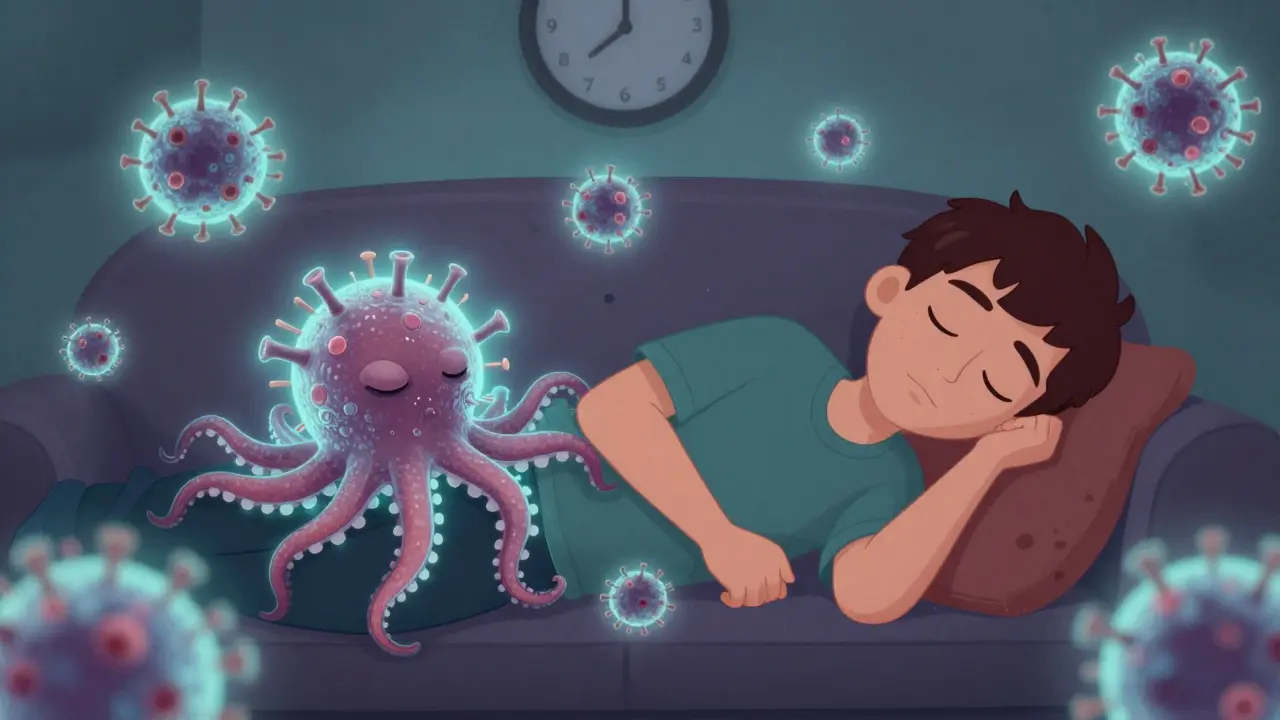
When you think of mono, you probably picture a sore throat, fever, and exhaustion that won’t quit. But behind that tired feeling is a quiet, persistent virus-Epstein-Barr-that’s been around longer than most people realize. It’s not just a bad cold. It’s not strep throat. And it doesn’t go away just because you rest for a few days. Mononucleosis, or "mono," is a viral infection that hits hardest in teens and young adults, leaving behind fatigue that can last for months. If you’ve been told to "just push through," you’re not alone. But here’s the truth: mono isn’t something you recover from overnight. It’s something you manage, carefully, over time.
What Exactly Is Epstein-Barr Virus?
Epstein-Barr virus (EBV) is one of the most common human viruses. Around 95% of Americans have been infected by age 35. Most never even know it. In kids, it often looks like a mild cold. But in teenagers and college students, it can turn into full-blown infectious mononucleosis. EBV is a type of herpesvirus, which means once it gets in your body, it never leaves. It hides quietly in your B-cells-immune cells that help fight infection-and wakes up now and then. For most people, that’s harmless. But during the first infection, it triggers a massive immune response that causes the classic symptoms of mono.
It spreads through saliva. That’s why it’s called "the kissing disease." But you don’t need to kiss someone to catch it. Sharing a drink, a fork, or even a water bottle can do it. The virus can be passed for weeks before symptoms show up, and even after they fade. That’s why it spreads so easily in dorms, sports teams, and classrooms.
The Classic Symptoms-And the One Nobody Talks About
Doctors look for three main signs: fever, sore throat, and swollen lymph nodes. But the real story is in the numbers. Over 98% of people with mono report extreme fatigue. That’s not just being tired after a long day. It’s the kind of exhaustion where even brushing your teeth feels like running a marathon. About 70-90% have swollen glands in the neck. Nearly 90% get a sore throat so bad it’s mistaken for strep-but antibiotics won’t help. In fact, if you take amoxicillin or ampicillin, you’re 80-90% likely to get a rash.
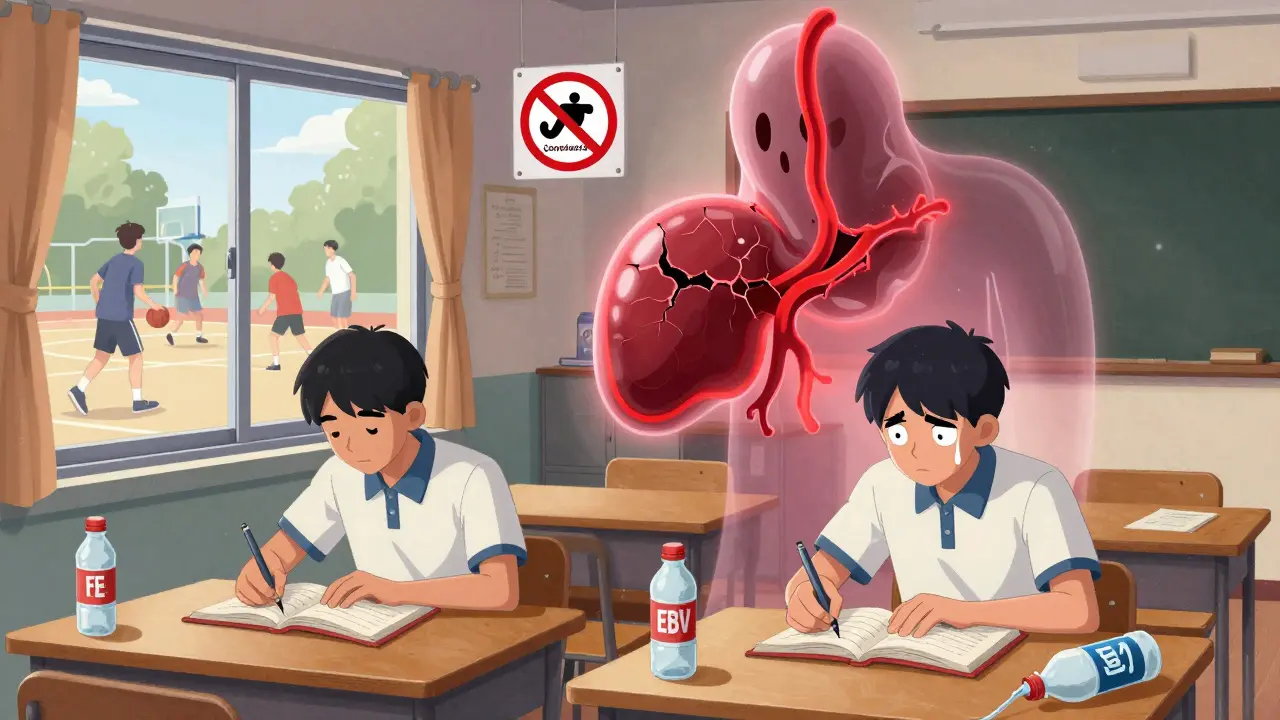
Half of all cases involve an enlarged spleen. That’s not something you feel. But if you ignore it, you risk a rupture-something rare, but life-threatening. That’s why doctors tell you to avoid contact sports. Not because you’ll feel worse. Because your spleen could burst from a bump, a fall, or even a hard cough.
Other symptoms include headaches (75%), muscle aches (65%), and jaundice (10%). Some people get a rash. Others don’t. The pattern isn’t the same for everyone. But the fatigue? That’s almost universal.
Why Recovery Takes So Long
Most people think mono lasts 2-4 weeks. That’s true for the fever and sore throat. But fatigue? That’s a different story. Studies show fatigue can last 2-4 months. In one Reddit community with over 15,000 members, a top post described taking 11 weeks to return to part-time work. Another user said, "I thought I was fine at week 3. Then, at week 5, just showering left me collapsed."
Why does it drag on? Because EBV doesn’t just make you sick-it rewires your immune system. Your body is still fighting, even after the fever is gone. Your energy levels aren’t just low-they’re out of sync. Trying to do too much too soon doesn’t make you recover faster. It makes you crash harder.
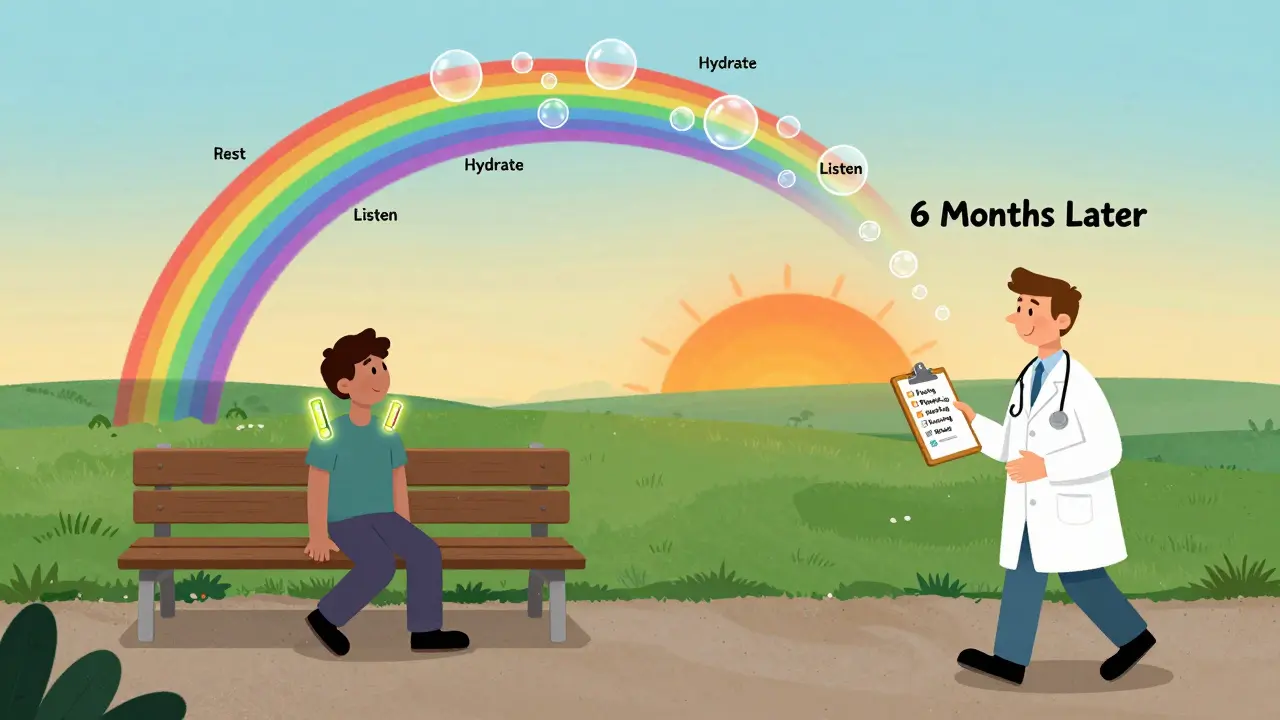
Doctors at Stanford and Mayo Clinic recommend a method called "Pacing, Prioritizing, Planning." Start at 50% of your pre-illness energy level. Do a little. Rest a lot. Track how you feel. If you feel worse after activity, you went too far. If you feel okay, wait a week before increasing by 10%. No rushing. No "grinding through." Your body isn’t broken-it’s rebuilding.
How It’s Diagnosed (And Why You Might Be Misdiagnosed)
Many people are first told they have strep throat. That’s because the sore throat and fever look the same. But strep responds to antibiotics. Mono doesn’t. If you get antibiotics and break out in a rash? That’s a red flag.
Doctors use two main tests. The Monospot test checks for heterophile antibodies. It’s about 85% accurate by the second week. But in the first week? It can be negative. That’s why some people get sent home, told it’s just a virus, and come back worse.
The real diagnosis comes from EBV-specific antibody tests: VCA-IgM (shows recent infection), VCA-IgG (lasts for life), and EBNA (appears months later). These tell you not just if you have mono, but when you got it. That’s important for knowing how long you’re contagious and how long your body might still be recovering.
What Actually Helps-And What Doesn’t
You won’t find a cure. There’s no antiviral that makes mono vanish. Acyclovir? It reduces viral shedding in lab studies, but doesn’t change how you feel. Steroids? They might shorten throat pain by 12 hours-but can cause mood swings, weight gain, and high blood sugar. The American Academy of Pediatrics doesn’t recommend them.
What does help?
- Rest: Not just sleep. Scheduled breaks. Two hours of quiet after lunch. No screens. No scrolling.
- Hydration: 20 ounces of water every few hours. Dehydration makes fatigue worse.
- Pain relief: Acetaminophen for fever and pain. Avoid NSAIDs like ibuprofen if your platelets are low (common in mono).
- Spleen protection: No contact sports for at least 4 weeks. Get an ultrasound before returning to wrestling, soccer, or football.
- Gradual return: Start with light walking. Then short walks with breaks. Then light chores. Then part-time work. No all-or-nothing.
Some people swear by the "20-20-20 rule": 20 minutes of activity, 20 minutes of rest, 20 ounces of water. It’s not magic. But it’s structure. And structure is what your body needs when it’s rebuilding.
Long-Term Risks and What’s New in Research
Most people bounce back fully. But mono leaves a mark. A 2022 Harvard study of 10 million people found that having mono raises your risk of multiple sclerosis (MS) by 1.3 times. That sounds scary-but the absolute risk is still tiny: 0.03%. Still, it’s one reason scientists are now studying EBV as a possible trigger for autoimmune diseases.
There’s exciting new research. A 2023 University of Toronto trial showed that low-dose naltrexone (LDN) reduced fatigue by 40% in people still struggling after 6 months. And in April 2023, Moderna started Phase I trials for an EBV vaccine. Early results showed 92% of participants developed protective antibodies.
The CDC updated its guidelines in June 2023 to require ultrasound clearance before student-athletes return to contact sports. That’s progress. More doctors are finally listening to patients who say, "I’m still exhausted."
What No One Tells You
You’re not lazy. You’re not weak. You’re not just "taking it easy." You’re healing from a virus that hijacked your immune system. And your body needs time to reset.
Many people feel guilty. They skip classes. They miss work. They cancel plans. They apologize for being tired. But here’s the thing: mono isn’t a choice. It’s a biological event. Your body is doing the hard work of recovery. And it doesn’t care about your deadlines.
The best thing you can do? Trust your fatigue. Listen to it. Don’t fight it. Let it guide you. Rest when you need to. Move when you can. And don’t let anyone tell you it’s "all in your head."
How long does mono fatigue last?
Fatigue from mono typically lasts 2 to 6 weeks, but in about 10-20% of cases, it can continue for 3 to 6 months. Most people start feeling better after 4 weeks, but full energy levels often take longer to return. Pushing too hard too soon can lead to setbacks.
Can you get mono more than once?
You don’t get "mono" again, but the Epstein-Barr virus stays in your body for life. It can reactivate without causing symptoms. In rare cases, especially in people with weakened immune systems, reactivation can lead to symptoms similar to mono. But for healthy people, a second bout of full-blown infectious mononucleosis is extremely uncommon.
Is mono contagious after symptoms go away?
Yes. The Epstein-Barr virus can remain in your saliva for months after symptoms fade. Some people continue to shed the virus for over a year. That’s why you can still pass it to others-even if you feel fine. Avoid sharing drinks, utensils, or toothbrushes for at least 6 months after diagnosis.
Why do antibiotics make the rash worse?
About 80-90% of people with mono who take ampicillin or amoxicillin develop a non-allergic rash. It’s not a true allergy-it’s a reaction between the virus and the antibiotic. The rash is harmless and fades on its own, but it can be mistaken for a penicillin allergy. That’s why doctors avoid these antibiotics for suspected mono.
When can I return to sports or exercise?
You should avoid contact sports and heavy lifting for at least 4 weeks. The biggest risk is spleen rupture, which can happen if your spleen is enlarged and you take a hit. Return only after a doctor confirms your spleen has returned to normal size via ultrasound. Light walking and stretching are usually fine after 2 weeks, as long as you don’t feel dizzy or tired.

Sneha Mahapatra
February 28, 2026 AT 04:04It’s wild how something so common-EBV-can feel so isolating when you’re in the middle of it. I remember being 22, convinced I was just lazy, until my doctor said, "This isn’t in your head, it’s in your cells." The fatigue wasn’t laziness-it was your immune system doing overtime, silently, without applause. I stopped apologizing for napping. Started treating rest like a ritual, not a reward. And slowly, the fog lifted. Not because I pushed harder. But because I finally stopped fighting my own body.
There’s no glory in mono. Just quiet resilience.
Gigi Valdez
March 2, 2026 AT 00:42The pacing strategy outlined here is clinically sound. The concept of energy envelope management-where activity is constrained by available physiological capacity-is well-documented in chronic fatigue literature. What’s refreshing is its application to a self-limiting infection. Most patients are misinformed by well-meaning but uninformed advice: "Just push through." The data is clear: graded activity, not forced exertion, yields sustainable recovery. I wish more primary care providers understood this.
Katherine Farmer
March 4, 2026 AT 00:17Let’s be real-this post reads like a pharmaceutical white paper with emotional padding. Yes, EBV is common. Yes, fatigue lasts. But the real issue? The medical system’s failure to validate chronic symptoms. You don’t need a 2023 Moderna vaccine trial to know this. You need a doctor who listens. Instead, we get blog posts dressed up as science, while patients are left to Google their way out of a systemic neglect. The tone is soothing, but the underlying message? You’re broken, and we’re the ones with the manual.
Charity Hanson
March 4, 2026 AT 12:24Yo I got mono in college and thought I was done after 3 weeks. Then I tried to run a 5K and collapsed in front of a gas station. I cried. Then I cried more because I thought I was weak. Turns out? My spleen was still swollen. I didn’t know. No one told me. This post? It’s the version of mono I wish I had. No shame. No pressure. Just facts wrapped in kindness. Thank you.
Lisa Fremder
March 4, 2026 AT 18:11They say EBV is linked to MS but they don’t tell you the CDC’s been suppressing data since the 90s. Big Pharma doesn’t want you to know the vaccine trials were sabotaged because if EBV is the trigger, then autoimmunity isn’t random-it’s preventable. And that means they lose billions. They’ll keep calling it "fatigue" while they patent new drugs for symptoms they could’ve stopped with a simple shot. Wake up. This isn’t science. It’s silence.
Full Scale Webmaster
March 6, 2026 AT 14:35Okay so let me get this straight-after 30 years of being told "it’s just a virus," now we’re supposed to believe that mono is some kind of immune reset protocol? That’s not science, that’s New Age nonsense wrapped in citations. I’ve seen people with mono bounce back in 10 days. Others take months. It’s not about pacing. It’s about your baseline health. Your diet. Your sleep hygiene. Your stress levels. But no, let’s just hand out a pamphlet and call it a diagnosis. Meanwhile, the real issue? We’ve turned a common infection into a cult. You’re not healing from a virus-you’re healing from the narrative.
And the 92% antibody rate from Moderna? That’s Phase I. They haven’t even tested efficacy in humans. Stop treating a trial like a miracle.
bill cook
March 6, 2026 AT 16:23So you’re telling me I can’t even hug my niece because I had mono 8 months ago? That’s insane. I’m not some walking biohazard. My body’s fine. I’m not contagious anymore. But now I’m supposed to avoid all physical contact for a year? And what about kissing my partner? Am I just supposed to ghost them forever? This isn’t recovery-it’s isolation with footnotes. Someone needs to stop hyping this up. It’s just a virus. We’ve all had worse.
Noah Cline
March 7, 2026 AT 12:03Let’s address the elephant in the room: the term "pacing" is a euphemism for disability management. This isn’t about recovery-it’s about adapting to permanent energy deficits. The fact that Stanford and Mayo Clinic are endorsing this suggests a paradigm shift in virology: from cure to containment. The data shows EBV reactivation correlates with mitochondrial dysfunction. That’s not a coincidence. It’s a signature. And if you’re still fatigued after 6 months, you’re not failing-you’re in a new physiological state. Accept it. Or keep pretending you’re just tired.
Ajay Krishna
March 8, 2026 AT 16:23As someone from India, I’ve seen this play out differently. In rural clinics, mono is often called "viral fever" and treated with rest and fluids. No tests. No ultrasounds. But people recover. Maybe because they don’t overthink it. No 20-20-20 rule. No pacing logs. Just sleep, dal, and chai. I’m not saying Western medicine is wrong. But maybe we’ve over-medicalized something that, for many, just needs time and quiet. Not algorithms. Not apps. Not trauma-informed recovery plans. Just space.
Sophia Rafiq
March 9, 2026 AT 21:00EBV = herpes family. That’s wild. I always thought herpes was just... you know. But this? It’s like your immune system got a lifetime membership to a club it didn’t sign up for. And now it’s stuck paying dues. I’m not mad. Just... impressed? Like, this virus is a masterclass in stealth. No cure? Fine. But the fact that 95% of us carry it and don’t even know? That’s evolution on mute. I’m just glad I didn’t get the kissing disease. I’m not that reckless.
Eimear Gilroy
March 10, 2026 AT 10:57I’ve been living with post-mono fatigue for 14 months. I’m 31. I work remotely. I nap at 3 p.m. I don’t go out on weekends. People think I’m depressed. My doctor says I’m fine. But I’m not. And I’m not asking for a cure. Just someone to say: "I see you. This is real." This post did that. Thank you. Not because of the stats. But because you didn’t say "it’ll pass." You said: "Your body is rebuilding." And that? That changed everything.
Angel Wolfe
March 10, 2026 AT 15:58They want you to believe the vaccine is coming but they already have one. It’s called the HPV vaccine. They just don’t want you to connect the dots. EBV is herpes. Herpes is linked to cancer. Cancer is big business. The CDC updated guidelines? Sure. After 20 years of silence. Why? Because patients started talking. And now they’re scared. So they give us pamphlets and ultrasounds. But the truth? They’re still not ready to admit this virus is a public health time bomb. Don’t trust the system. Trust your body.
Byron Duvall
March 10, 2026 AT 19:36So I got mono in 2021. I felt fine after 3 weeks. Then I went to the gym. Got dizzy. Fainted. Woke up in the ER. They said my spleen was 3x normal size. I was 21. I didn’t know. No one told me. Now I’m 25. I still get tired if I lift heavy. I don’t play sports. I don’t kiss. I don’t share drinks. And I’m fine with it. But here’s the thing: if I hadn’t read this exact post, I’d still be blaming myself. Instead? I know I’m not weak. I’m just a survivor of a virus that no one talks about. And that’s okay.