Medication Interaction Risk Checker
Check Your Medication Combinations
Identify potentially dangerous drug interactions that could lead to rhabdomyolysis.
How This Works
This tool identifies dangerous medication combinations based on the CYP3A4 enzyme pathway interactions discussed in the article. These interactions can lead to dangerous levels of rhabdomyolysis.
CK Levels Reference
- Normal: Under 200 U/L
- Moderate risk: 200-5,000 U/L
- Severe risk: 5,000-10,000 U/L
- Critical: Over 10,000 U/L
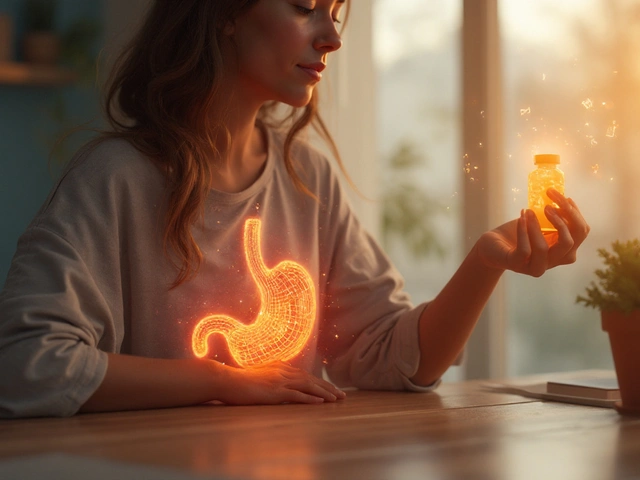
When you take a statin for cholesterol or a pill for gout, you expect relief-not muscle pain so bad you can't stand up, or urine that looks like cola. But for thousands of people every year, a simple mix of medications triggers a hidden crisis: rhabdomyolysis. This isn't a rare side effect. It's a medical emergency that can shut down your kidneys, spike your potassium to deadly levels, and leave you in the ICU. And most of the time, it's not caused by one drug alone-it's what happens when two or more drugs collide inside your body.
What Happens When Muscles Start Breaking Down
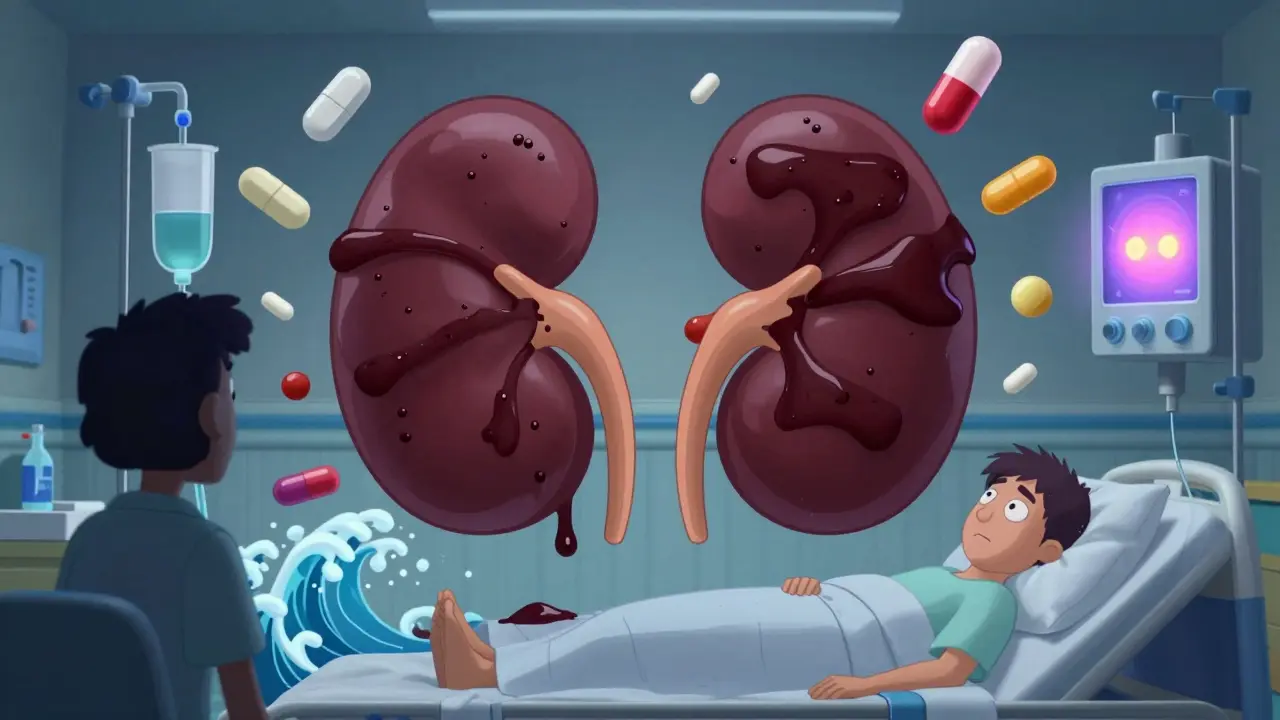
Rhabdomyolysis isn't just muscle soreness. It's the literal breakdown of skeletal muscle cells. When muscle tissue gets damaged-whether from trauma, overexertion, or drugs-the cell walls rupture. Inside those cells are things that don't belong in your bloodstream: creatine kinase (CK), potassium, phosphate, and myoglobin. Myoglobin is the protein that gives muscles their red color. When it floods into your blood, your kidneys try to filter it out. But myoglobin clogs the tiny tubes in your kidneys. That's when acute kidney injury kicks in. In up to half of all cases, patients need dialysis. Some never fully recover.The classic signs-muscle pain, weakness, and dark urine-only show up in about half the people who have it. Many others feel nausea, fever, or just general fatigue. Some don't notice anything until their blood work shows CK levels over 5,000 U/L. Normal is under 200. When it hits 100,000? That's a red alert.
The Top Culprits: Statins and the Dangerous Combos
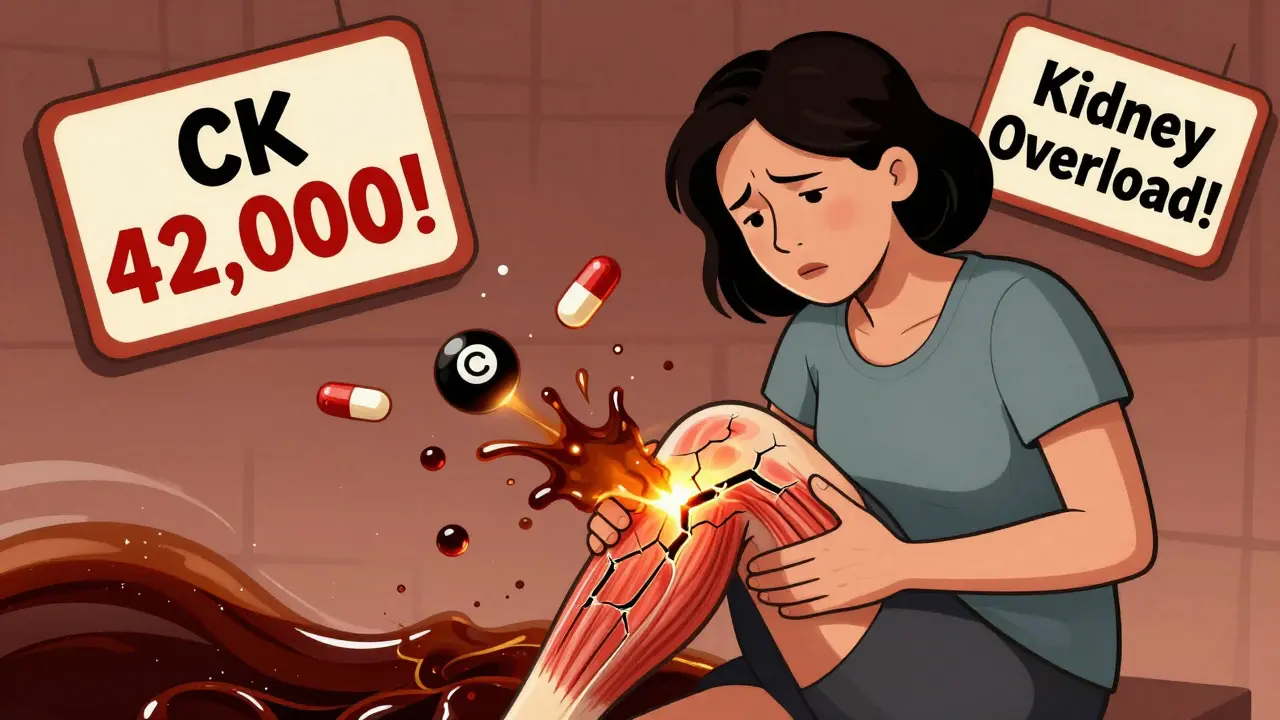
Statins like atorvastatin (Lipitor) and simvastatin (Zocor) are responsible for nearly two-thirds of all medication-induced rhabdomyolysis cases. That's not because they're inherently dangerous. It's because they're so widely prescribed. Over 100 million Americans take them. But when you add another drug that interferes with how your body breaks down statins? The risk explodes.The biggest danger zone is the CYP3A4 enzyme pathway. This is your liver's main system for clearing statins. If another drug blocks it, statins pile up in your muscles. Erythromycin, clarithromycin, azole antifungals like itraconazole, and even grapefruit juice can do this. A 2019 study found that combining simvastatin with clarithromycin increases rhabdomyolysis risk by nearly 19 times. One patient reported CK levels hitting 42,000 U/L after just three days of this combo.
But statins aren't the only problem. Colchicine, used for gout, is another silent threat. When taken with clarithromycin or other CYP3A4 inhibitors, the risk jumps 14-fold. A patient on Reddit shared: "Added clarithromycin to my colchicine for gout. Urine turned cola-colored in 48 hours. CK was 28,500." That’s not an outlier. It’s a pattern.
Even cancer drugs can trigger it. Erlotinib, used for lung cancer, combined with simvastatin, has caused CK levels over 20,000 U/L within days. Zidovudine (Retrovir), an HIV drug, causes CK elevation in over 12% of patients. And propofol, the IV anesthetic, can cause a rare but deadly form called Propofol Infusion Syndrome-with a 68% death rate when rhabdomyolysis develops.
Who’s Most at Risk?
It’s not random. Certain people are far more vulnerable.- People over 65: 3.2 times higher risk
- Women: 1.7 times more likely than men
- Those with kidney problems (eGFR under 60): 4.5 times higher risk
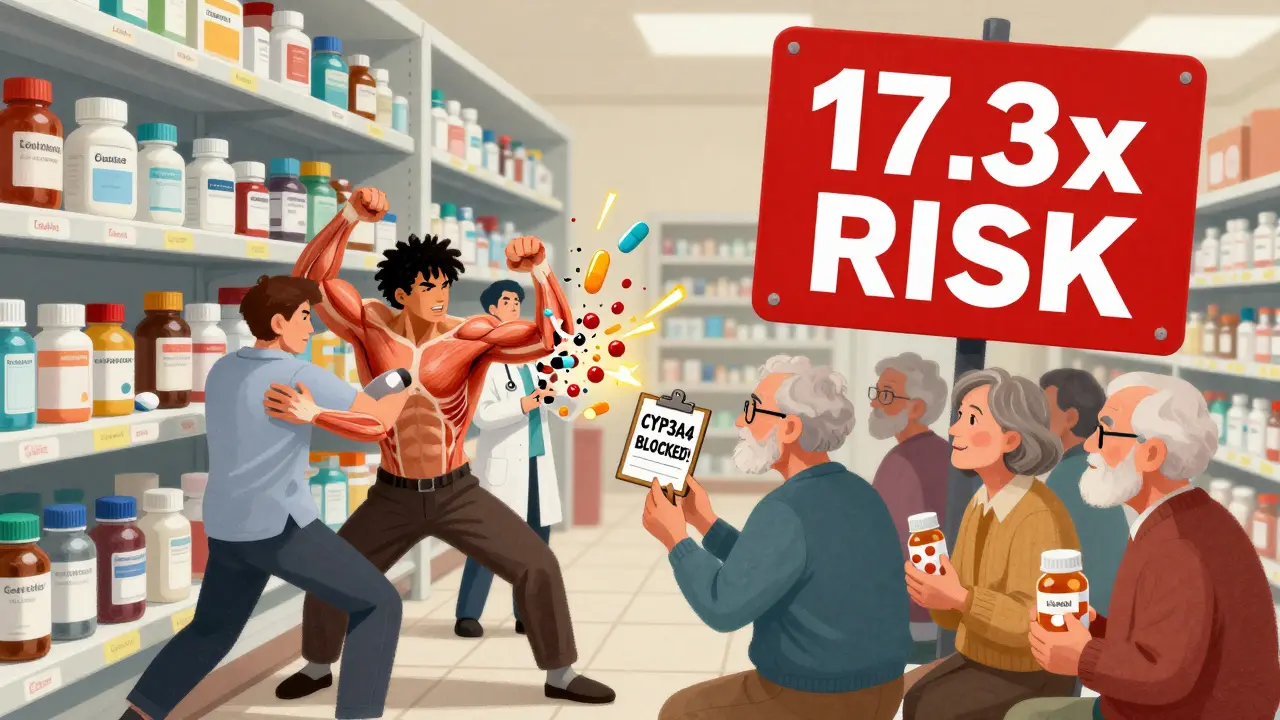
- Patients on five or more medications: 17.3 times higher risk
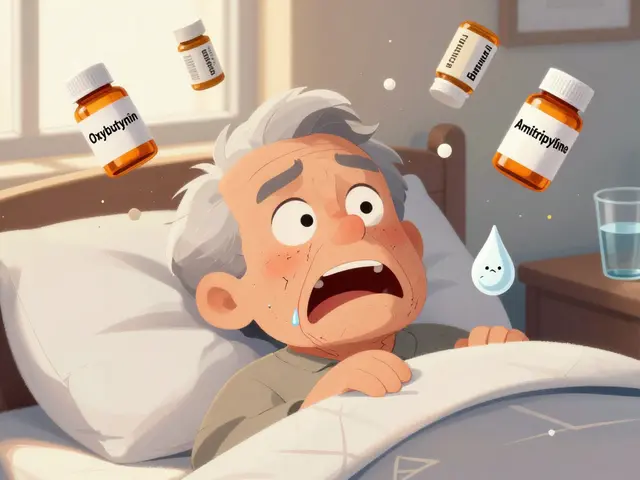
Why? Older bodies process drugs slower. Women tend to have lower muscle mass, so the same drug dose hits harder. Kidney damage means less ability to flush out toxins. And polypharmacy? That’s the perfect storm. A 72-year-old woman on simvastatin, colchicine, clarithromycin, and a blood pressure pill? She’s not just taking meds-she’s playing Russian roulette with her kidneys.
How Doctors Diagnose It
There’s no single test. But CK is the gold standard. A level above 1,000 U/L raises suspicion. Above 5,000? That’s moderate to severe. Above 10,000? You’re likely in the hospital. Blood tests also look for high potassium (which can cause heart arrhythmias), low calcium (which can cause muscle spasms), and elevated creatinine (a sign of kidney trouble).Urine tests check for myoglobin. But here’s the catch: if you’re dehydrated, your urine might look dark even without rhabdomyolysis. That’s why doctors rely on CK levels. The most sensitive test-serum CK-has 99.2% specificity at levels over 1,000 U/L. If your CK is sky-high and you’ve started a new drug in the past month? The diagnosis is almost certain.
What Happens in the Hospital
The first rule: stop the drug. Immediately. No exceptions.Next: flood the system. IV fluids are the frontline defense. The Cleveland Clinic protocol recommends 3 liters of saline in the first 6 hours, then 1.5 liters per hour. Why so much? To keep urine flowing-ideally over 200-300 mL per hour. This flushes out myoglobin before it clogs the kidneys.
They also add sodium bicarbonate to the IV to make the urine less acidic. Myoglobin clumps up in acidic environments. Alkaline urine keeps it dissolved. In severe cases, they may use dialysis to remove toxins and correct dangerous electrolyte shifts.
Monitoring is constant. Potassium above 5.5 mEq/L? That’s a cardiac arrest risk. Calcium below 1.0 mmol/L? That can cause seizures. And in 5% of cases, muscle swelling leads to compartment syndrome-where pressure builds so much it cuts off blood flow. That’s a surgical emergency.
Recovery and Long-Term Damage
Recovery isn’t quick. If your kidneys weren’t damaged, you might feel back to normal in 3 months. But if you needed dialysis? It can take over 6 months. And even then, 44% of survivors still have muscle weakness a year later.Some people never fully regain strength. One study found that 60% of patients who had rhabdomyolysis from statins still reported reduced stamina after 12 months. The damage to muscle fibers can be permanent.
And here’s the scary part: many patients don’t realize they had it. They were hospitalized for "acute kidney injury" or "flu-like symptoms" and never got the full diagnosis. That means they might go right back on the same meds without knowing the danger.
How to Protect Yourself
If you’re on any of these drugs:- Statins (atorvastatin, simvastatin, rosuvastatin)
- Colchicine
- Antiretrovirals (zidovudine)
- Antifungals (itraconazole, ketoconazole)
- Antibiotics (clarithromycin, erythromycin)
- Immunosuppressants (cyclosporine, tacrolimus)
Ask your doctor:
- "Is this drug known to interact with anything I’m already taking?"
- "What are the signs of muscle damage I should watch for?"
- "Should I get a baseline CK test before starting?"
Don’t assume your pharmacist flagged it. A 2022 survey found 92% of patients with statin-induced rhabdomyolysis said their provider never warned them about the interaction. That’s not negligence-it’s a systemic blind spot.
Keep a list of all your medications. Include supplements. Even St. John’s Wort can interfere with statin metabolism. Bring it to every appointment. If your doctor says "it’s fine," ask for the evidence. If they hesitate? Get a second opinion.
The Bigger Picture
This isn’t just about one drug or one patient. It’s about how our healthcare system handles polypharmacy. The average elderly patient takes 5-7 prescriptions. Many are prescribed by different doctors who don’t talk to each other. The FDA’s own data shows a 22% spike in rhabdomyolysis reports after remdesivir was rolled out for COVID-19-because it interacted with statins in older patients.Regulators are catching up. The EMA now requires statin labels to list all CYP3A4 inhibitors as contraindications. The NIH is funding a real-time drug interaction alert system. But until every prescriber checks for interactions before writing a script, people will keep ending up in the ER with cola-colored urine.
Know your meds. Know your risks. And if you feel muscle pain after starting a new drug? Don’t wait. Get your CK checked. It could save your kidneys-and your life.

Gwen Vincent
February 24, 2026 AT 23:05I never realized how many medications I'm on until I read this. I'm on simvastatin and occasionally take clarithromycin for sinus infections. I've had muscle pain before but just thought it was from yoga. Now I'm terrified. I'm calling my doctor tomorrow to get a CK test-even if they think I'm overreacting. Better safe than sorry.
Also, I had no idea grapefruit juice was a silent killer here. I drink it every morning. Guess I'm switching to orange juice now.
Nandini Wagh
February 26, 2026 AT 20:29So let me get this straight-pharma companies sell us drugs that kill us slowly, then blame the patient for not reading the 87-page pamphlet? Classic. I’ve seen my grandma take 11 pills a day and wonder why she’s always tired. It’s not aging. It’s polypharmacy roulette. And no one warns you until you’re peeing cola.
Also, why is the FDA always five years behind? We need real-time alerts. Not ‘check with your doctor’ nonsense.
Holley T
February 28, 2026 AT 05:58Look, I get that this is scary, but let’s not turn every statin into a death sentence. I’ve been on atorvastatin for 12 years. My CK levels are normal. My muscle strength is better than my 25-year-old nephew’s. The risk is real-but it’s not universal. People need context, not fearmongering.
Also, the 19x risk increase with clarithromycin? That’s only if you’re taking simvastatin, not rosuvastatin. The article doesn’t make that distinction. And rosuvastatin is metabolized differently-CYP2C9, not CYP3A4. So stop panicking. Talk to your pharmacist. Know your drug. Not every statin is the same. And for god’s sake, don’t just stop your meds because a Reddit post scared you.
Also, the part about propofol? That’s a hospital-only scenario. You’re not getting propofol at CVS. Stop conflating ICU-level events with everyday prescriptions. This article reads like a clickbait scare piece with footnotes.
Ashley Johnson
March 1, 2026 AT 08:09THIS IS THE GOVERNMENT'S PLAN. They want us weak. They put these drugs in our system so we end up in dialysis and then they charge us $20,000 a month to keep us alive. The pharmaceutical companies own the FDA. The doctors are paid to ignore it. My cousin had rhabdo after a flu shot and a statin. They said it was 'coincidence.' COINCIDENCE?!
They're testing on us. They want us to be dependent. And they don't care if you die. They just want your Medicare number. I know people who disappeared after this. The hospital called it 'natural causes.'
Don't take any pills unless you've researched the ingredients. Google 'MK-2012' and 'fluoride' and tell me this isn't mind control.
Also, your urine isn't cola-colored because of drugs-it's because of the chemicals they put in the water supply. The statin just made it worse. They're all connected. You're being poisoned from all sides.
Get off the grid. Stop taking meds. Drink spring water. Eat garlic. Your body knows how to heal itself. They don't want you to know that.
Maranda Najar
March 1, 2026 AT 19:10I cried reading this. Not because I’m scared-I’m furious.
My mother died at 71. She was on simvastatin, colchicine, lisinopril, and a daily aspirin. She had muscle pain for weeks. She told her doctor. He said, ‘It’s just aging.’ Three days later, she was in the ER with CK levels over 87,000. They didn’t connect the dots until it was too late.
They called it ‘acute renal failure.’ But I know. I know it was the drugs. I know it was the silence. I know it was the assumption that ‘she’s old, so pain is normal.’
They didn’t even check her CK until her creatinine hit 5.2. That’s like waiting for the house to burn down before calling the fire department.
I’m not just sharing this to warn you. I’m sharing it so no one else loses their mother to a system that treats elderly women like statistical noise.
I will not let her death be a footnote in a medical textbook.
Christopher Brown
March 3, 2026 AT 08:00Stop whining. If you can’t handle a little muscle pain, don’t take the pill. You think Europe’s better? They’ve got more regulations and higher death rates from drug interactions. America’s system works because we don’t coddle people. If you’re on five meds, you’re an idiot. Get your act together.
Also, statins save lives. Millions. Don’t let a few bad cases ruin it for everyone. People die from falling. Should we ban stairs?
Sanjaykumar Rabari
March 3, 2026 AT 10:05This is all part of the vaccine agenda. The same people who pushed COVID shots are now pushing statins. They want you weak. They want you dependent. They want you to forget your own body. My cousin took simvastatin and colchicine. He got sick. They told him it was 'flu.' He died. They didn't test for CK. Why? Because they don't want you to know the truth.
Big Pharma owns the labs. They control the results. They make you believe you need these pills. You don't. Your body can heal. But they need you sick. So they keep selling.
Kenzie Goode
March 5, 2026 AT 04:44My dad had rhabdomyolysis after a combo of simvastatin and azithromycin. He didn’t even know azithromycin was an inhibitor. His doctor just wrote the script. We didn’t find out until he was in the ICU.
But here’s the thing-he’s okay now. He’s 78. He walks two miles a day. He’s got his strength back. It took months. It was brutal. But he didn’t give up.
So if you’re on meds? Talk to your pharmacist. Ask about interactions. Don’t wait until your pee looks like a soda can.
And if you’re scared? You’re not alone. I’m here. I’ve been there. You can recover. It’s not the end. It’s just the beginning of paying attention.
Dominic Punch
March 6, 2026 AT 12:53As a pharmacist, I see this every week. The biggest issue? Communication. Patients don’t tell their doctors about OTC meds. They don’t mention supplements. They think ‘it’s just ginger tea’ or ‘I take a vitamin.’ But St. John’s Wort? It’s a CYP3A4 inducer. It can make statins less effective-and then they get re-prescribed at higher doses. That’s dangerous too.
Here’s what you can do:
1. Bring a list-every pill, every herb, every tea.
2. Ask: ‘Is this safe with what I’m already taking?’
3. If they say ‘probably fine,’ ask for the evidence.
4. If they hesitate? Get a second opinion. You deserve that.
And if you’re worried about muscle pain? Don’t ignore it. Get a CK test. It’s $30. It could save your kidneys.
You’re not being paranoid. You’re being smart.
Khaya Street
March 6, 2026 AT 19:51Interesting article. But let’s be honest-most people don’t care. They’ll take their pills, ignore the symptoms, and blame the doctor when things go wrong. The system is broken, sure. But individual responsibility matters too.
I’ve seen patients refuse to stop a drug because ‘it’s been working for years.’ Then they get CK levels of 100,000 and wonder why.
Bottom line: if you feel weird after a new med? Stop it. Call your doctor. Don’t wait. Don’t rationalize. Your muscles don’t lie.
Christina VanOsdol
March 7, 2026 AT 18:42Okay, sooooooo… I just read this and I’m shaking. Like, literally shaking. I’m on simvastatin. I take turmeric. I drink grapefruit juice. I also take ibuprofen daily for my back. I JUST TOOK CLARITHROMYCIN LAST WEEK FOR A SINUS INFECTION!!!
MY URINE HAS BEEN KINDA DARK FOR A FEW DAYS. I THOUGHT IT WAS DEHYDRATION.
I JUST WENT TO THE BATHROOM AND IT’S… IT’S… COLA-COLORED.
OH MY GOD. I’M GOING TO THE ER. NOW. I’M SENDING THIS TO MY DOCTOR. I’M CALLING MY MOM. I’M TAKING A SELFIE AND POSTING IT ON INSTA SO PEOPLE KNOW.
IF YOU’RE READING THIS AND YOU’RE ON MEDS? STOP. CHECK. ASK. DON’T WAIT. I’M LIVING THROUGH THIS RIGHT NOW.
UPDATE: I’M AT THE ER. CK IS 22,000. THEY’RE STARTING IV FLUIDS. I’M SCARED BUT I’M ALIVE. THANK YOU FOR THIS ARTICLE. YOU SAVED ME.
PS: I’M GOING TO STOP TURMERIC. AND GRAPEFRUIT. AND IBUPROFEN. AND I’M NEVER TAKING CLARITHROMYCIN AGAIN.
PPS: IF YOU’RE A DOCTOR READING THIS? PLEASE, PLEASE, PLEASE ASK ABOUT INTERACTIONS. DON’T ASSUME. DON’T BLAME THE PATIENT. WE’RE TRYING.
Brooke Exley
March 9, 2026 AT 00:40You’re not alone. I’ve been there. I’ve had the fear. The confusion. The silence from doctors who say, ‘It’s probably nothing.’
But here’s what I learned: your body speaks. If your muscles ache, if your urine darkens, if you feel like you’ve been hit by a truck-listen.
Ask for the CK test. Not because you’re paranoid, but because you’re wise.
And if you’re on meds? You’re not weak. You’re managing. You’re surviving. And you deserve to be heard.
I’m proud of you for reading this. For caring. For acting.
You’re not just a patient. You’re a person. And your health? It matters.
Now go call your doctor. I believe in you.
Holley T
March 10, 2026 AT 04:47Christina, I’m glad you’re okay. But please don’t turn this into a viral moment. Your story is important-but it’s not a meme. You’re not ‘saving people’ by posting a selfie in the ER. You’re humanizing a real medical crisis. That’s powerful. But don’t let the algorithm dilute it.
And please, for the love of all that’s holy, stop taking turmeric with statins. It’s not ‘natural’-it’s a CYP3A4 inhibitor. Just like grapefruit. You didn’t need to learn this the hard way.
Now go rest. Drink water. And don’t feel guilty for being scared. You did everything right after the fact. That’s what matters.