DOAC Renal Dosing & Safety Calculator
Patient Parameters
Results & Recommendations
Apixaban (Eliquis)
ABC Criteria CheckStandard: 5 mg BID
Recommendation: --
Rivaroxaban (Xarelto)
CrCl DependentStandard: 20 mg Daily
Recommendation: --
Dabigatran (Pradaxa)
CrCl DependentStandard: 150 mg BID
Recommendation: --
Edoxaban (Savaysa)
CrCl DependentStandard: 60 mg Daily
Recommendation: --
You have atrial fibrillation. Your doctor prescribes a Direct Oral Anticoagulant (DOAC) to prevent strokes. It sounds simple until you realize your kidneys aren't working at full capacity. This is where things get tricky. DOACs are cleared from your body by your kidneys. If your kidneys are slow, the drug builds up. Too much drug means a higher risk of severe bleeding. Too little means a stroke might happen. Getting the dose right isn't just about reading a label; it's about understanding how your specific kidney function interacts with these powerful medications.
We used to rely on warfarin for everyone, but the landscape has shifted dramatically. As of 2023, DOACs account for nearly 87% of prescriptions for stroke prevention in atrial fibrillation. They are safer and more predictable than warfarin for most people. However, that predictability vanishes if you ignore renal impairment. The core problem isn't the drug itself-it's the mismatch between the standard dose and your reduced ability to clear it. Let's look at exactly how to adjust these doses to keep you safe.
The Golden Rule: Use Cockcroft-Gault, Not eGFR
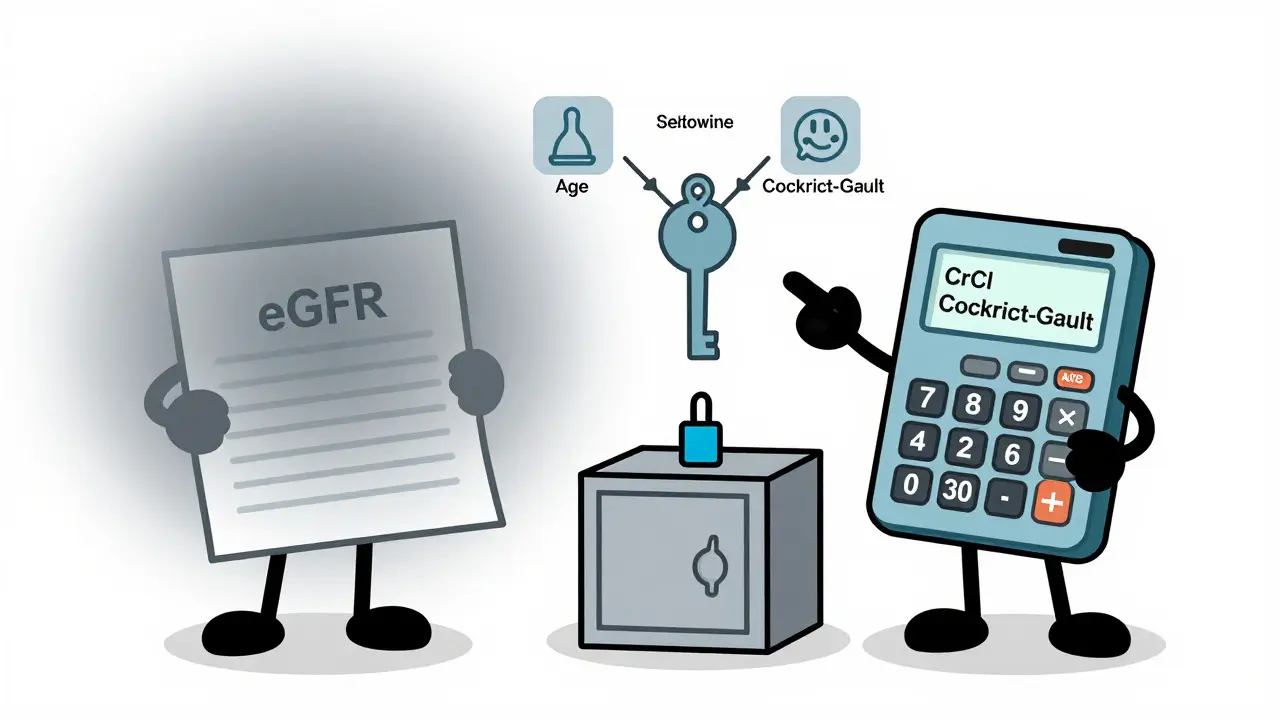
Here is the biggest mistake clinicians make when prescribing blood thinners for patients with kidney issues: they use the wrong number. You have likely seen estimated glomerular filtration rate (eGFR) on your lab results. It is the standard metric for staging chronic kidney disease (CKD). But for DOAC dosing, eGFR is often misleading.
To avoid side effects, you must calculate Creatinine Clearance (CrCl) using the Cockcroft-Gault formula. Developed in 1976, this equation remains the gold standard recommended by the FDA since 1998 for renal dosing adjustments. Why? Because eGFR normalizes values based on body surface area, which can overestimate kidney function in small or elderly patients. The Cockcroft-Gault formula uses age, weight, gender, and serum creatinine to give a raw clearance value in mL/min. This specific value determines whether you take the full dose, a reduced dose, or no dose at all.
- eGFR: Used for diagnosing and staging CKD (Stage 1-5).
- CrCl (Cockcroft-Gault): Used exclusively for calculating drug dosing adjustments.
If your doctor looks only at your eGFR, you might end up with a dose that is too high. Always ask: "Did you calculate my CrCl using Cockcroft-Gault?"
Dosage Adjustments by Drug
Not all DOACs behave the same way in renal impairment. Each of the four major agents-apixaban, rivaroxaban, dabigatran, and edoxaban-has distinct rules. Ignoring these differences is a primary cause of adverse events.
| Drug Name | Standard Dose | Renal Adjustment Criteria | Contraindicated When |
|---|---|---|---|
| Apixaban (Eliquis) | 5 mg twice daily | Reduce to 2.5 mg twice daily if patient meets two or more of: Age ≥80, Weight ≤60 kg, Serum Creatinine ≥1.5 mg/dL (133 μmol/L). Also used for CrCl 15-29 mL/min. | CrCl <15 mL/min (though some guidelines allow use in ESRD with caution) |
| Rivaroxaban (Xarelto) | 20 mg once daily (with evening meal) | Reduce to 15 mg once daily for CrCl 15-50 mL/min. | CrCl <15 mL/min |
| Dabigatran (Pradaxa) | 150 mg twice daily | Reduce to 75 mg twice daily for CrCl 15-30 mL/min. | CrCl <15 mL/min |
| Edoxaban (Savaysa/Lixiana) | 60 mg once daily | Reduce to 30 mg once daily for CrCl 15-50 mL/min. | CrCl <15 mL/min |
Why Apixaban Often Wins in Kidney Disease
Among the options, Apixaban generally shows the most favorable safety profile in patients with advanced kidney disease. Unlike the others, its dosing reduction relies on a combination of factors (age, weight, and creatinine) rather than renal function alone. This is crucial because serum creatinine levels can be deceptively low in elderly patients with low muscle mass, masking poor kidney function.
Research published in the Journal of the American Heart Association (2020) indicates that apixaban is associated with lower risks of major bleeding compared to warfarin in patients with end-stage renal disease (ESRD). In fact, many nephrologists now prefer apixaban for dialysis patients, despite limited large-scale trial data. A real-world report from Dr. Sarah Kim noted major bleeding rates of only 1.8% in ESRD patients on adjusted-dose apixaban, compared to 3.7% on warfarin.
However, there is a trap. A case reported by Dr. Michael Chen highlighted a 78-year-old ESRD patient who suffered life-threatening gastrointestinal bleeding while on the standard dose of apixaban (5 mg twice daily), even though he met criteria for reduction. This underscores the importance of strict adherence to the "ABC" mnemonic for apixaban reduction:
- Age ≥ 80 years
- Body weight ≤ 60 kg
- Creatinine ≥ 1.5 mg/dL
If you hit two of these three, you need the lower dose. Missing this step turns a protective drug into a hazard.
The Dialysis Dilemma: What About Stage 5 CKD?
When CrCl drops below 15 mL/min, or when a patient starts hemodialysis, the guidelines become controversial. This is known as End-Stage Renal Disease (ESRD). Historically, warfarin was the default choice here, but it carries significant risks, including vascular calcification and intracranial hemorrhage.
The 2018 ACC/AHA/HRS guidelines recommend either warfarin or apixaban for ESRD patients with atrial fibrillation. Rivaroxaban, dabigatran, and edoxaban are generally contraindicated or not recommended due to lack of safety data. The KDIGO 2023 Controversies Conference acknowledged that quality evidence for any specific agent in hemodialysis patients remains lacking. The AXIOS trial, which aimed to compare apixaban versus warfarin in this population, was terminated early due to poor enrollment, leaving a gap in definitive proof.
Despite this, clinical practice is shifting. By 2026, projections suggest that 15-20% of ESRD patients with AF will be receiving DOACs, primarily apixaban, driven by real-world data showing better bleeding outcomes than warfarin. If you are on dialysis, the decision requires a nuanced discussion between your cardiologist and nephrologist. There is no one-size-fits-all answer yet, but apixaban is increasingly viewed as the safer bet over warfarin.
Monitoring and Avoiding Errors
Prescribing errors are common. A multicenter study published in JAMA Internal Medicine (2022) found that 37.2% of DOAC prescriptions in CKD patients had dosing errors. The most frequent error was failing to reduce the dose when renal function declined.
To avoid side effects, you need active monitoring. Renal function is not static. It can decline rapidly during dehydration, heart failure exacerbations, or after taking certain antibiotics. The FDA recommends assessing renal function before starting a DOAC and at least annually thereafter. For patients with unstable kidney function, check every 3 to 6 months.
Virtual anticoagulation clinics, sometimes called "anticoagulation clouds," have proven effective in reducing adverse events by 22.7%. These services help track lab results and alert providers when CrCl crosses critical thresholds (like dropping below 30 or 15 mL/min). If you are managing your own health records, set up alerts for your creatinine levels. Know your baseline CrCl. If it changes, your dose might need to change too.
Reversal Agents and Emergency Planning
One advantage of DOACs over warfarin is the availability of specific reversal agents. If you suffer a major bleed or need emergency surgery, doctors don't have to wait days for the drug to wear off. Idarucizumab reverses dabigatran. Andexanet alfa reverses apixaban, rivaroxaban, and edoxaban. Prothrombin complex concentrate (PCC) is also used as a non-specific reversal option.
However, in renal impairment, the half-life of these drugs is prolonged. Even with reversal agents, residual anticoagulant effect may linger longer than expected. This makes accurate initial dosing even more critical. You want to avoid the emergency room entirely by preventing the bleed through correct dosing.
Summary of Key Actions
Managing blood thinners with kidney disease requires precision. Here is your checklist to stay safe:
- Calculate CrCl: Ensure your doctor uses the Cockcroft-Gault formula, not just eGFR.
- Check the Criteria: For apixaban, verify the ABC criteria (Age, Body weight, Creatinine). For others, check the specific CrCl cutoffs.
- Monitor Regularly: Test kidney function at least yearly, or more often if you are elderly or have fluctuating health.
- Review Medications: Avoid NSAIDs (like ibuprofen) which can worsen kidney function and increase bleeding risk.
- Communicate: Tell every specialist you see that you are on a DOAC and have kidney impairment.
Can I take apixaban if I am on dialysis?
Yes, apixaban is increasingly used in patients on hemodialysis (ESRD), although it is technically off-label in some regions. Guidelines from the ACC/AHA support its use. It is generally preferred over warfarin due to a lower risk of major bleeding. However, it should be prescribed with caution and close monitoring by a specialist.
Why is eGFR not used for DOAC dosing?
eGFR is normalized to body surface area, which can overestimate kidney function in small, elderly, or muscular individuals. The Cockcroft-Gault formula calculates actual creatinine clearance (CrCl) in mL/min, which correlates better with drug elimination rates. Using eGFR can lead to overdosing in vulnerable patients.
What happens if I miss a dose of my blood thinner?
If you miss a dose, take it as soon as you remember on the same day. If it is almost time for the next dose, skip the missed dose. Do not double up to make up for a missed dose, as this increases bleeding risk. Consistency is key to maintaining stable blood levels.
Is warfarin safer than DOACs for kidney patients?
Generally, no. Recent studies show that DOACs, particularly apixaban, have lower rates of major bleeding and intracranial hemorrhage compared to warfarin, even in patients with moderate to severe CKD. Warfarin is associated with higher risks of vascular calcification and requires frequent blood testing (INR monitoring), which is difficult for many patients.
How often should I check my kidney function while on a DOAC?
The FDA recommends checking renal function before starting therapy and at least annually thereafter. However, if you have existing chronic kidney disease, are over 75 years old, or have conditions like heart failure, your doctor may recommend checks every 3 to 6 months to ensure your dose remains appropriate.