
When you pick up a generic drug at the pharmacy, you expect it to work just like the brand-name version. But what you might not realize is that the labeling on that bottle or box is just as critical as the medicine inside. The FDA doesn’t just require generic drugs to have the same active ingredient, strength, and dosage form as the brand-name drug - it demands that the labeling be identical too. And that’s not just a formality. It’s a legal requirement with real consequences for patient safety.
Identical Labeling Is the Rule - Not the Exception
Under Section 505(j)(2)(A)(v) of the Federal Food, Drug, and Cosmetic Act, generic drug manufacturers must submit an Abbreviated New Drug Application (ANDA) that proves their product is bioequivalent to the Reference Listed Drug (RLD). That means the generic must match the brand-name drug in every way - except for things like color, shape, or inactive ingredients. But when it comes to labeling, the rules are even stricter. The FDA requires that the prescribing information, patient package inserts, and medication guides be word-for-word the same as the RLD’s labeling.This includes everything from the boxed warning at the top of the label to the fine print about drug interactions, side effects, and dosing instructions. The only permitted differences are the manufacturer’s name and address, the National Drug Code (NDC) number, and minor formatting changes due to packaging constraints. Even then, those changes can’t alter the meaning or clarity of the information.
Why does this matter? Because doctors, pharmacists, and patients rely on that label to make safe decisions. If a generic drug’s label says “use with caution in kidney disease” but the brand’s label says “contraindicated in kidney disease,” someone could be put at serious risk. The FDA’s goal is consistency - no confusion, no guesswork, no variations in safety messaging.
The Physician Labeling Rule (PLR) and Its Impact
Since 2006, all new prescription drug labels in the U.S. have followed the Physician Labeling Rule (PLR). This format organizes information into 24 standardized sections, making it easier for clinicians to find what they need quickly. The sections include: Highlights of Prescribing Information, Recent Major Changes, Indications and Usage, Dosage and Administration, Contraindications, Warnings and Precautions, Adverse Reactions, Drug Interactions, Use in Specific Populations, and more.Generic drugs must adopt the PLR format as soon as the RLD does. That means if the brand-name drug updates its label to include a new boxed warning about liver toxicity, the generic version must follow - and fast. The FDA expects generic manufacturers to update their labeling “at the earliest time possible” after the RLD change is approved. But here’s where things get complicated.
The Safety Gap: Why Generic Labels Lag Behind
Brand-name drugmakers can update their labels using a “Changes Being Effected” (CBE) supplement. That means they can add new safety information to their label immediately - even before the FDA approves the change - as long as they notify the agency within 30 days. It’s a system built for speed.Generic manufacturers don’t have that option. They must wait for the RLD to update its label, then wait for the FDA to approve the RLD’s change, and only then can they submit their own labeling update. This creates a dangerous delay. A 2024 study in JAMA Internal Medicine found that this regulatory gap affects 9,400 generic drug products - representing 89% of all prescriptions filled in the U.S. - and can delay critical safety updates by 6 to 12 months.
One real-world example was the 2022 valsartan recall. When contamination risks were discovered in the brand-name version, generic manufacturers couldn’t update their labels to warn patients until the RLD’s labeling change was approved. By then, thousands of patients had already been exposed to unsafe medication. The FDA issued a Drug Safety Communication, but the delay meant the warning didn’t reach everyone at the same time.
Who’s Responsible for Monitoring Changes?
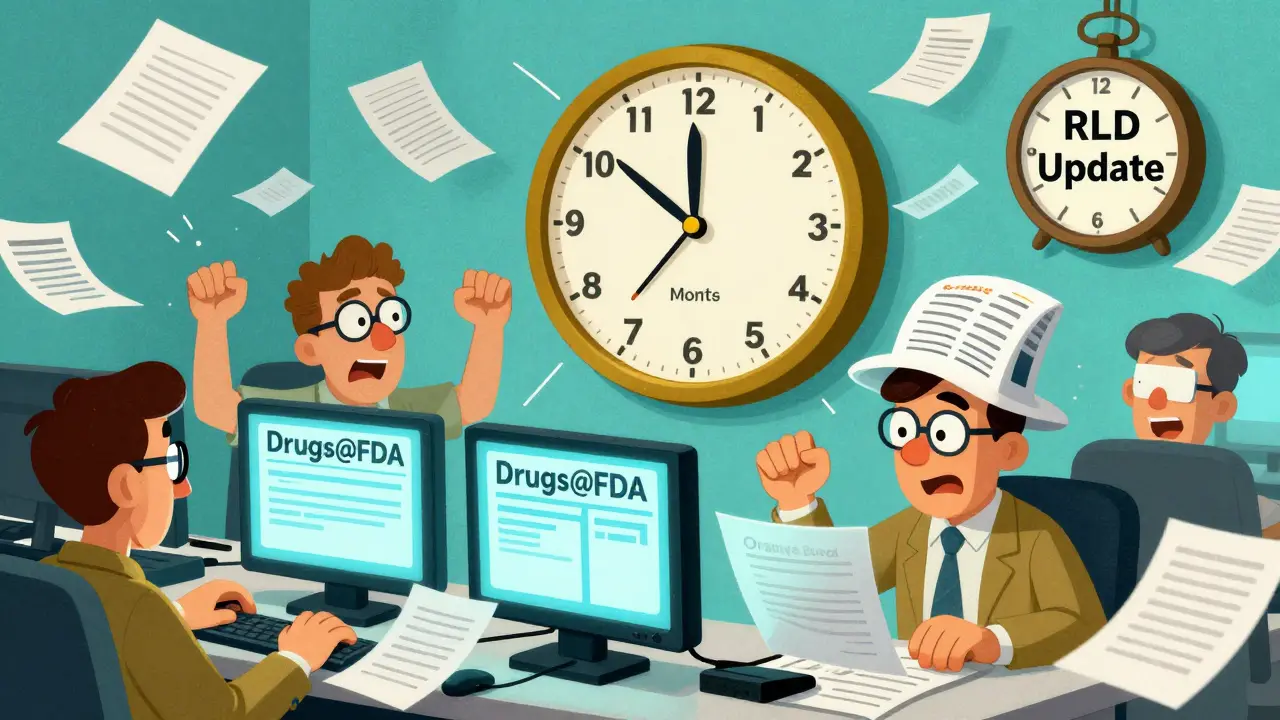
The FDA doesn’t call generic manufacturers to say, “Hey, the brand just changed its label.” It’s up to the manufacturer to track those changes themselves. The primary tool for this is Drugs@FDA, the FDA’s official database of approved drug labeling. As of January 2025, it contains 2,850 reference listed drugs, with updates published every Tuesday.But it’s not easy. A 2024 FDA audit found that 17% of RLD entries in the Orange Book had temporary inconsistencies with Drugs@FDA during labeling transitions. That means manufacturers can’t rely on just one source. They have to cross-check multiple databases, subscribe to FDA email alerts, and often hire dedicated staff to monitor changes across dozens of products.
Leading generic manufacturers dedicate 3 to 5 full-time regulatory affairs staff for every 50 approved products. Small companies spend an average of $147,500 per year per product just to keep labels compliant. Large companies like Teva, Viatris, and Sandoz have entire departments of 50 to 120 people focused on labeling. And even then, mistakes happen.
What Happens When Labels Are Out of Date?
The FDA’s Division of Labeling Review (DLR) reviews about 1,200 ANDA submissions each year. Labeling issues are the number one reason for complete response letters - accounting for 37% of all rejections in fiscal year 2024. But the bigger problem is post-approval violations.Between January 2023 and December 2024, the FDA issued 47 warning letters specifically citing outdated or incorrect generic drug labeling as the primary violation. These aren’t small slips. They’re failures to update critical safety information. The FDA can take enforcement actions, including product seizures, injunctions, or even halting production.
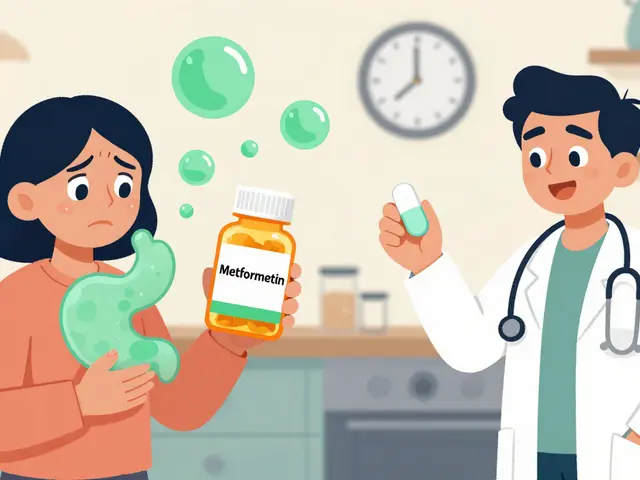
And it’s not just about legal risk. Pharmacists and patients notice. A March 2025 Reddit thread on r/pharmacy had over 140 comments from pharmacists frustrated by outdated generic labels. One wrote: “I had to explain to a patient why their metformin label didn’t mention the new lactic acidosis risk - even though the brand’s label had it for six months.”
What’s Changing in 2025 and Beyond?
The FDA knows the system is broken. In 2020, the MODERN Labeling Act gave the agency new authority to update labeling for generic drugs even when the RLD has been discontinued - a problem affecting over 1,200 withdrawn reference products and 3,500 generic drugs. Draft guidance was released in January 2025 to help manufacturers navigate this.More importantly, the FDA has proposed a rule change that would allow generic manufacturers to update labeling with new safety information using the same CBE process as brand-name companies - without waiting for RLD approval. This rule is still pending as of January 2026, but if approved, it would be the biggest shift in generic labeling since the PLR was introduced.
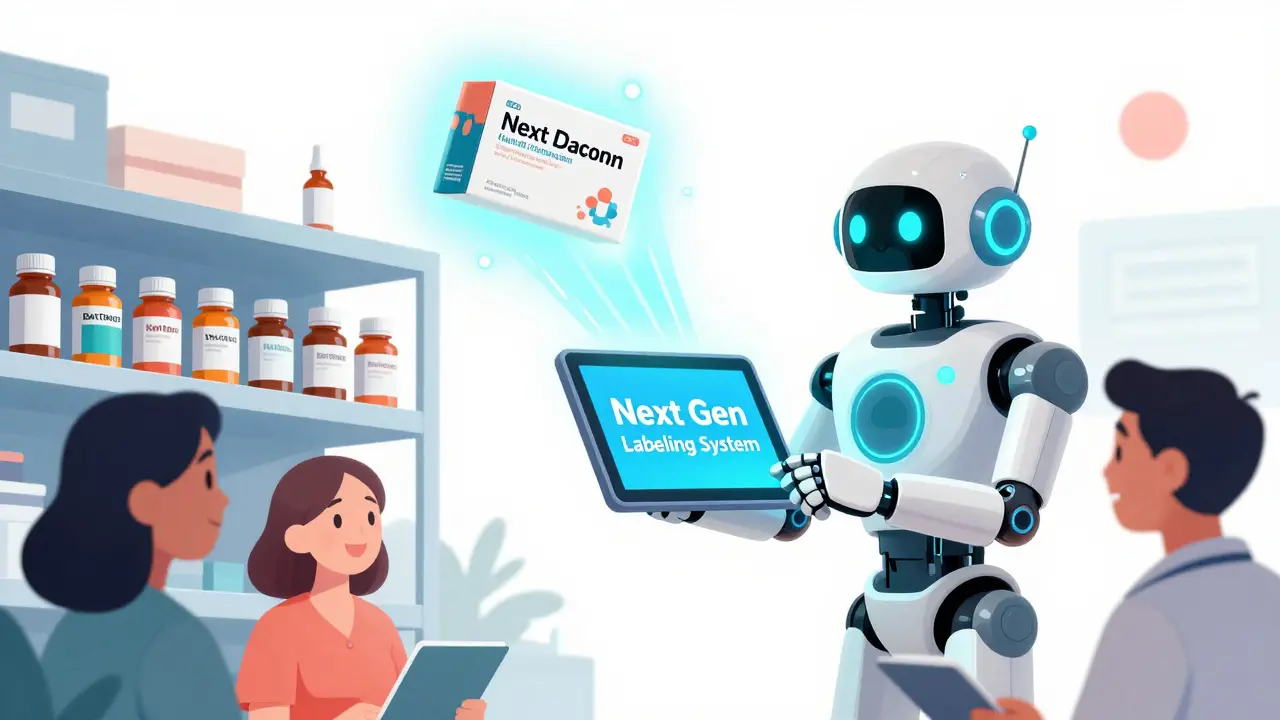
Looking ahead, the FDA plans to launch its Next Generation Generic Drug Labeling System in Q3 2025. This AI-powered tool will automatically detect labeling changes in the RLD and send alerts to manufacturers. Beta testing begins in April 2025 with 15 major companies. The goal? To cut the delay from months to days.
What Patients and Providers Should Know
As a patient, you should always check the label on your generic medication - especially if you’ve switched brands recently. If something seems off, ask your pharmacist. They can check Drugs@FDA to confirm whether the label is current.As a prescriber, don’t assume the generic label matches the brand. Verify with the FDA database if a recent safety alert came out. And if you’re prescribing a drug with a withdrawn RLD, be extra cautious - those labels may be outdated, even if they look fine.
The system is designed for uniformity. But uniformity doesn’t mean safety if the information is stale. The FDA’s rules are clear: labeling must be identical. But the real challenge is making sure that identical label is always up to date - for everyone.
Can generic drug labels be different from brand-name labels?
No, generic drug labels must be identical to the Reference Listed Drug (RLD) in content, wording, and structure - with only three exceptions: the manufacturer’s name and address, the National Drug Code (NDC), and minor formatting changes due to packaging. Any other difference is a violation of FDA regulations under 21 CFR 314.94(a)(8).
Why don’t generic manufacturers update labels as quickly as brand-name companies?
Brand-name companies can use a "Changes Being Effected" (CBE) supplement to update safety information immediately and notify the FDA within 30 days. Generic manufacturers must wait for the RLD to update its label first, then wait for the FDA to approve that change before they can update their own. This creates delays of 6 to 12 months, a gap that has raised serious safety concerns.
How do generic drug companies track labeling changes?
They primarily use Drugs@FDA, the FDA’s official database of approved drug labeling, which updates every Tuesday. Leading companies also subscribe to FDA email alerts, monitor the Orange Book, and cross-check with other regulatory databases. Many hire dedicated regulatory affairs staff - 3 to 5 per 50 products - to ensure they don’t miss updates.
What happens if a generic drug label is outdated?
The FDA can issue warning letters, seize products, or halt manufacturing. Between 2023 and 2024, 47 warning letters were issued specifically for labeling violations. Outdated labels also put patients at risk - especially if critical safety warnings, like new contraindications or black box alerts, are missing.
Will the FDA allow generic manufacturers to update labels independently in the future?
Yes, the FDA has proposed a rule change that would allow generic manufacturers to update labeling with new safety information using the same CBE process as brand-name companies. This rule is still pending as of January 2026, but if approved, it would eliminate the current delay and bring generic labeling into alignment with modern safety standards.
Christine Joy Chicano
January 7, 2026 AT 16:36It’s wild how the FDA treats generic labels like they’re photocopies instead of life-or-death documents. The fact that a patient could get a version of metformin without the lactic acidosis warning for half a year because the manufacturer is waiting on paperwork? That’s not regulation-that’s negligence dressed up as bureaucracy.
Vince Nairn
January 7, 2026 AT 18:15so like... if the brand name drug gets updated and the generic doesn't for 8 months... who gets sued when someone dies? 🤔
Adam Gainski
January 9, 2026 AT 07:11Actually, the system isn’t as broken as it seems. Generic manufacturers are required to monitor Drugs@FDA and the Orange Book daily. The delays happen because they’re not always staffed properly-small firms can’t afford 5 full-time regulators per 50 products. It’s a resource issue, not a policy failure.
That said, the proposed CBE rule change is long overdue. If brand-name companies can act fast on safety updates, generics should too. Why should a patient on a $3 generic pay the price for corporate inefficiency?
Mina Murray
January 9, 2026 AT 18:23They’re not just slow-they’re complicit. The FDA lets this happen because big pharma owns the system. The brand-name companies profit from their own patents, then the generics get stuck playing catch-up while people die. It’s not a glitch-it’s the design.
And don’t get me started on how the Orange Book is often out of sync with Drugs@FDA. I’ve seen it myself. A manufacturer checks the wrong database, misses a warning, and suddenly half the country’s on a dangerous version. The FDA doesn’t audit this. They just send out warning letters after the fact.
They call it "uniformity." I call it a death sentence with a barcode.
Poppy Newman
January 11, 2026 AT 14:05Wow this is terrifying 😳 I had no idea my $4 generic could be missing critical warnings. I always assumed "same active ingredient" meant "same everything". Guess not. Time to start checking Drugs@FDA myself... 🙃
Anastasia Novak
January 13, 2026 AT 08:10Oh please. You think this is about safety? It’s about control. The FDA doesn’t want generics to have autonomy because then they’d lose the illusion of oversight. They’d rather have a 12-month delay than admit the system is rigged to favor Big Pharma’s monopolies.
And don’t act surprised when people die. This isn’t an accident-it’s a feature.
steve rumsford
January 14, 2026 AT 21:54so i just got my generic lisinopril and the label says "avoid grapefruit" but the brand one says "no interaction"... and i'm supposed to trust this? nope. nope nope nope.
Kamlesh Chauhan
January 16, 2026 AT 00:21why even bother with generics if theyre gonna be wrong half the time
just charge me for the brand name
Jessie Ann Lambrecht
January 17, 2026 AT 04:32This is why I always print out the latest FDA labeling for my patients and hand them a copy. I don’t trust the bottle. I don’t trust the pharmacy’s database. I trust the official Drugs@FDA PDF-and I make sure they do too.
If you’re on a generic, especially for something cardiac or psychiatric, ask your pharmacist for the most recent label version. Don’t wait for a tragedy to wake you up.
And if you’re a provider? Stop assuming. Verify. Every. Single. Time.
Alex Danner
January 18, 2026 AT 18:58Let’s not forget the real villain here: the FDA’s slow approval pipeline. Even if a generic manufacturer submits a labeling update the day after the RLD changes, it takes 4–8 weeks just to get a review slot. Meanwhile, the patient is still on the old label.
The Next Gen Labeling System might help-but only if they actually fund it. Right now, the FDA’s budget for generic oversight is a joke. They’re asking for real-time updates with 1990s tech and a skeleton crew.
Emma Addison Thomas
January 20, 2026 AT 10:40Interesting how the UK handles this differently-we have a centralized electronic prescribing system that auto-updates labels across all generics when the RLD changes. No delays. No databases to cross-check. Just... done.
Maybe the US needs to stop reinventing the wheel and just borrow what works.
Andrew N
January 22, 2026 AT 04:09the study cited has a small sample size and the jama paper was observational so causation cant be established
also the 17% inconsistency rate in the orange book is within normal variance for regulatory databases
no real danger here just fearmongering
Jonathan Larson
January 23, 2026 AT 01:57There’s a deeper philosophical question here: if a drug’s safety information is identical in content but delayed in delivery, is it truly identical? The law says yes. The patient’s body says no.
Regulation is meant to protect, not to preserve bureaucratic hierarchy. When the system prioritizes procedural purity over human life, it ceases to be legitimate-not just inefficient, but morally bankrupt.
Perhaps the real question isn’t how to fix the labeling gap-but whether we’re willing to accept a system that lets people die while paperwork clears.
Elen Pihlap
January 24, 2026 AT 14:49my cousin died because her generic blood pressure med didn't have the warning and now i hate everything
Kyle King
January 25, 2026 AT 03:13wait so the FDA is basically forcing generic companies to be zombies who only move when the brand-name drug waves a flag? what if the brand-name company goes out of business? does the generic just stop updating forever? this is a horror movie script