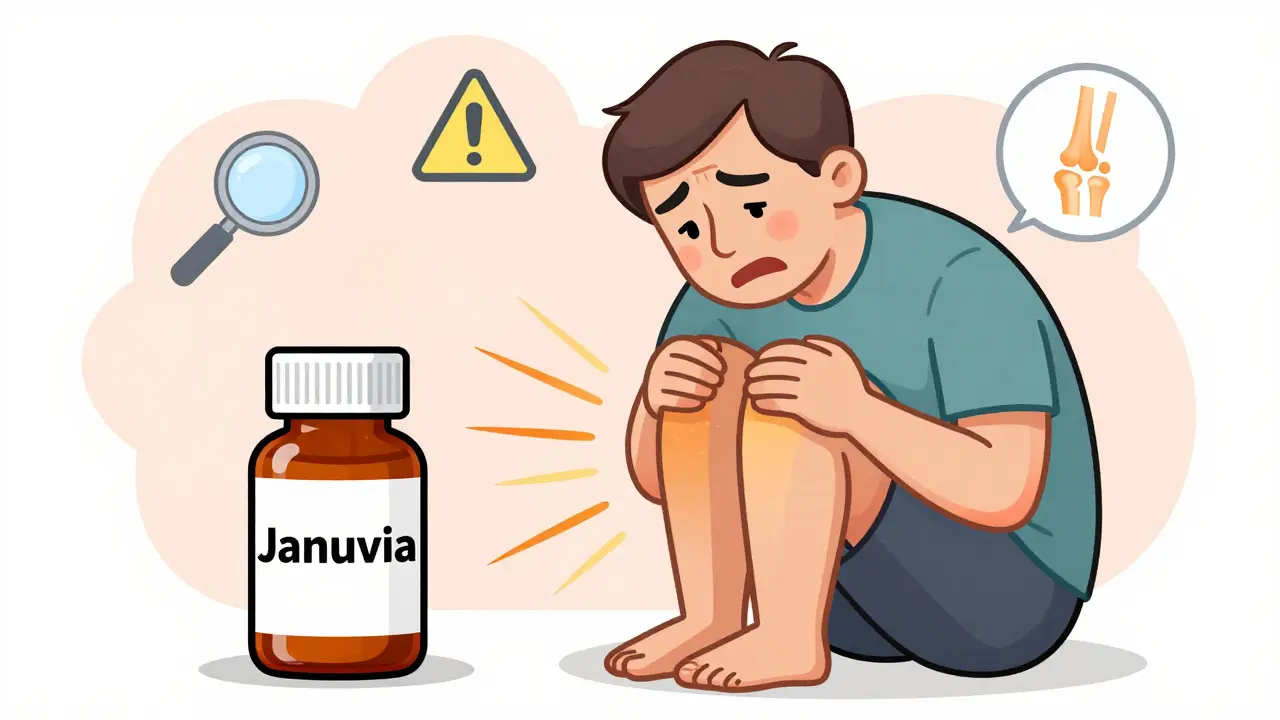
If you’re taking a DPP-4 inhibitor for type 2 diabetes and suddenly can’t walk without hurting, it’s not just bad luck. Severe joint pain is a real, documented side effect - and it’s more common than most doctors tell you.
What Are DPP-4 Inhibitors?
DPP-4 inhibitors are oral diabetes drugs that help your body make more insulin after meals and reduce the sugar your liver releases. They’re not new - sitagliptin (Januvia) hit the market in 2006, and since then, four others followed: saxagliptin (Onglyza), linagliptin (Tradjenta), alogliptin (Nesina), and vildagliptin (Galvus). These pills are popular because they don’t cause weight gain or low blood sugar on their own, and they’re easy to take - once a day, with or without food.
But here’s the catch: they’re not harmless. While they help control blood sugar, they can also trigger something unexpected - intense, disabling joint pain. And it doesn’t always show up right away. Some people feel it after three weeks. Others don’t notice it until they’ve been on the drug for a year.
The FDA Warning You Might Not Have Heard
In August 2015, the U.S. Food and Drug Administration (FDA) issued a safety alert that changed everything. After reviewing reports from over 7 years of use - from 2006 to 2013 - they found 33 cases of severe joint pain directly linked to DPP-4 inhibitors. That might sound small, but each case was devastating.
Twenty-two of those patients developed pain within a month of starting the drug. Ten were hospitalized. Twenty-three saw their pain disappear within a month after stopping the medication. Eight had their pain come back within days when they restarted it - a classic sign the drug was the cause.
The FDA didn’t pull these drugs off the market. They just added a bold warning to the labels: “Severe and disabling joint pain has been reported.” They told doctors: “Consider DPP-4 inhibitors as a possible cause when patients with diabetes develop new joint pain.”
Who’s Most at Risk?
It’s not just one drug. The pain showed up with all of them - but sitagliptin was the most common culprit, linked to 28 of the 33 cases. Saxagliptin followed with 5. Linagliptin and alogliptin had fewer reports, but they still caused it.
Age doesn’t seem to protect you. The FDA cases included people in their 40s to 70s. Gender? No clear pattern. But what stood out was how sudden and severe the pain was. People described it as:
- Burning or stabbing pain in both knees or hips
- Swelling that made walking impossible
- Joint stiffness so bad they couldn’t get out of bed
One 58-year-old woman started sitagliptin and within three weeks, her knees felt like they were breaking. She couldn’t work, couldn’t walk to the store. After stopping the drug, her pain vanished in two weeks. Then she accidentally took it again - and the pain returned within 48 hours.
This isn’t just a few odd cases. A 2021 study using real-world data from over 250 million Americans found that people taking DPP-4 inhibitors had a 24% higher risk of needing medical care for joint pain compared to those on other diabetes meds. That’s not rare. It’s real.

Why Does This Happen?
We don’t have a full answer yet. DPP-4 inhibitors block an enzyme that breaks down incretin hormones - good for blood sugar. But that same enzyme also helps regulate inflammation. When it’s blocked, immune signals may go haywire, triggering joint inflammation in some people. It’s not arthritis. It’s not lupus. It’s a drug-induced reaction that looks like both.
Some patients are misdiagnosed for months. One man in Texas spent six months seeing rheumatologists, getting MRI scans, and trying steroids - until his endocrinologist asked, “When did you start Januvia?” He stopped the drug. The pain was gone in 10 days.
What Does the Evidence Really Say?
Not every study agrees. A large analysis of 67 clinical trials found only a small increase in general joint discomfort - not the severe, disabling kind. Another study in Taiwan found no link at all. But here’s the problem: those studies didn’t look for severe pain. They didn’t track rechallenge. They used broad diagnostic codes like “joint pain” - which could mean anything from a sprained ankle to a drug reaction.
The FDA’s data is different. It’s based on real patient reports - the kind that end up in emergency rooms. And when patients stop the drug and feel better? That’s not coincidence. That’s cause and effect.
Even the American Diabetes Association admits the risk is low - but they also say: “Don’t ignore it.” With over 35 million prescriptions for sitagliptin alone in the U.S. each year, even a 0.1% risk means thousands of people could be affected.
What Should You Do If You Have Joint Pain?
Don’t panic. Don’t stop your medicine cold. But don’t wait either.
If you’re on a DPP-4 inhibitor and you develop new, unexplained joint pain - especially if it’s:
- Severe enough to limit your movement
- Worse in both knees, hips, or shoulders
- Not linked to injury or overuse
Call your doctor. Say: “I think this might be related to my diabetes pill.” Bring up the FDA warning. Ask if your drug is a DPP-4 inhibitor.
Most doctors will test your blood sugar and check for other causes - but if nothing else fits, they should consider stopping the drug. In most cases, pain fades within days to weeks after stopping. If it comes back when you restart? That’s your answer.
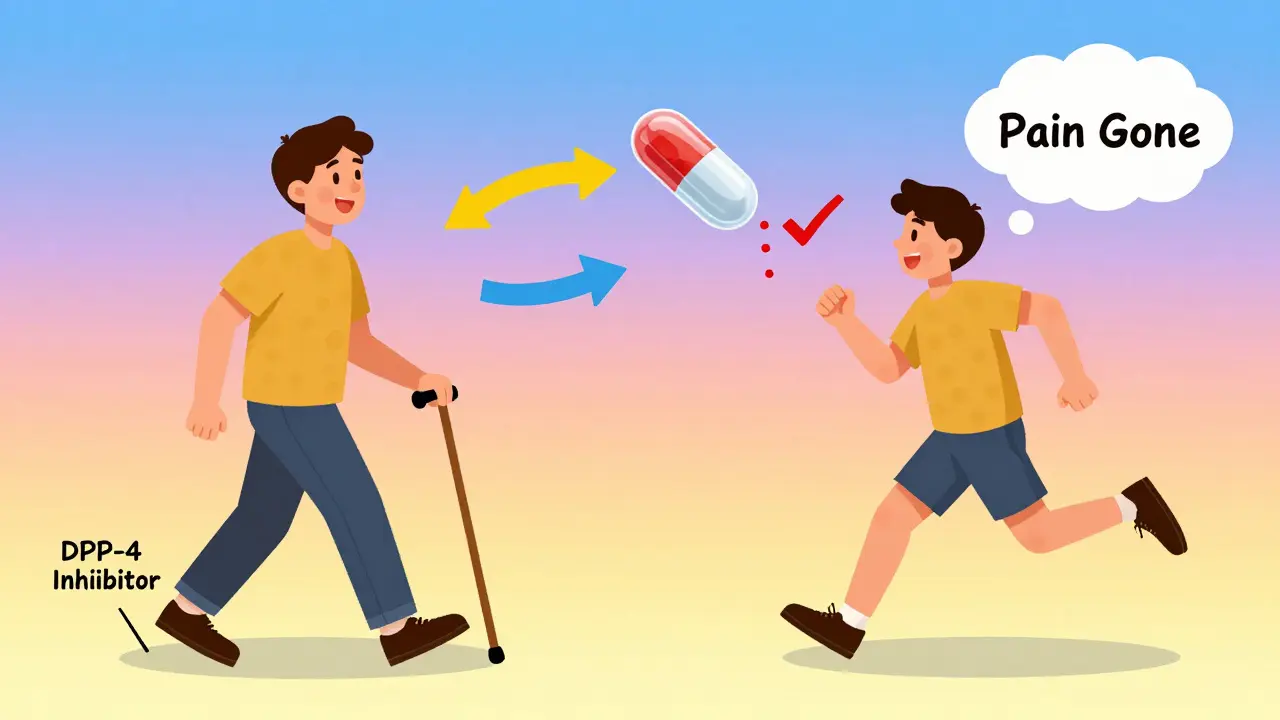
Alternatives If You Need to Stop
If your joint pain is linked to your DPP-4 inhibitor, you have options:
- Metformin - still the first-line drug. Cheap, well-studied, rarely causes joint pain.
- SGLT2 inhibitors - like empagliflozin or dapagliflozin. They help with weight loss and heart protection, but can cause yeast infections or dehydration.
- GLP-1 agonists - like semaglutide. These are injectables, but very effective and often used in people who need more than pills.
- Insulin - if your diabetes has progressed, insulin might be the best next step.
Your doctor can help you switch safely. Never stop your diabetes meds without guidance - high blood sugar is dangerous too.
Other Side Effects to Watch For
Joint pain isn’t the only risk. DPP-4 inhibitors have been linked to:
- Pancreatitis - severe belly pain, nausea, vomiting
- Severe skin reactions - blisters, peeling skin (like bullous pemphigoid)
- Allergic reactions - swelling of the face, tongue, throat
- Low blood sugar - if you’re also on sulfonylureas or insulin
If you get blisters, swelling, or sudden, intense stomach pain - go to the ER. Don’t wait.
Bottom Line
DPP-4 inhibitors work for many people. They’re convenient. They’re generally safe. But if you’re experiencing unexplained, severe joint pain - it could be the drug.
You’re not imagining it. You’re not crazy. You’re not just getting older.
It’s a known side effect - one that’s been confirmed by the FDA, real-world data, and patient stories. And the good news? It usually goes away when you stop taking the pill.
Don’t suffer in silence. Talk to your doctor. Ask the question. Your joints might thank you.
Can DPP-4 inhibitors cause joint pain even after years of use?
Yes. While most cases of joint pain start within the first month, some patients develop symptoms after six months or even a year of taking the drug. The FDA has documented cases where pain appeared after long-term use, and symptoms resolved after stopping the medication. This means you shouldn’t assume it’s just aging or arthritis - especially if the pain is sudden and severe.
Is joint pain from DPP-4 inhibitors permanent?
No. In 23 out of 33 confirmed FDA cases, joint pain fully resolved within one month after stopping the drug. In most patients, improvement begins within days. If pain returns after restarting the medication, it confirms the link. Permanent damage is extremely rare - the pain is a reaction, not a degenerative condition.
Which DPP-4 inhibitor has the highest risk of joint pain?
Sitagliptin (Januvia) has the most reported cases - 28 out of 33 in the FDA’s analysis. Saxagliptin (Onglyza) followed with 5. All DPP-4 inhibitors carry the warning, but sitagliptin is the most commonly prescribed, so it appears more often in reports. That doesn’t mean the others are safe - just that they’re used less frequently.
Should I stop taking my DPP-4 inhibitor if I have joint pain?
Don’t stop on your own. Contact your doctor immediately. Stopping diabetes medication without a plan can raise your blood sugar dangerously. Your doctor will help you decide whether to switch drugs and how to manage your blood sugar during the transition. In most cases, switching to another diabetes medication resolves the pain safely.
How common is joint pain from DPP-4 inhibitors?
Mild joint discomfort affects about 5-10% of users in clinical trials, but severe, disabling pain is rare - estimated at less than 0.1%. However, with over 35 million prescriptions for sitagliptin alone each year in the U.S., even a 0.1% risk means thousands of people could be affected. The FDA’s warning exists because the consequences are serious, even if the frequency is low.
Are there any tests to confirm DPP-4 inhibitor-induced joint pain?
There’s no specific blood test or scan. Diagnosis is based on timing, pattern, and response to stopping the drug. If joint pain starts shortly after beginning the medication, affects both sides of the body, and improves after stopping - it’s likely linked. A rechallenge (restarting the drug) that causes pain to return is the strongest proof - but doctors usually avoid this unless absolutely necessary.



Jeremy Hendriks
December 22, 2025 AT 23:18They call it a 'side effect' like it's a sneeze. Nah. This is your body screaming that the drug is hacking your immune system. They didn't pull these pills because profits outweigh pain. And now we're supposed to just 'talk to your doctor'? Like they even know what's happening. The FDA warning is a Band-Aid on a gunshot wound.
Art Van Gelder
December 23, 2025 AT 04:16Man, I read this and I just... sat there. Like, I know diabetes is a beast, but this? This is the kind of thing that makes you wonder if we're being sold snake oil wrapped in white coats. I’ve got a cousin on Januvia-no joint pain yet, but she’s got this weird rash she won’t mention. I’m gonna send her this article. Not because I’m some medical guru, but because I’ve seen too many people get lost in the system. We treat meds like candy-pop one, no big deal. But what if the body’s not the one that’s broken? What if the system is?
Tarun Sharma
December 24, 2025 AT 19:46Thank you for this well-researched summary. The FDA warning is often overlooked by clinicians. Patients should be informed proactively.
Jim Brown
December 26, 2025 AT 16:45There is a profound epistemological dissonance in modern pharmacology: we prioritize statistical anonymity over individual suffering. The FDA’s 0.1% figure is a mathematical abstraction-yet for the person whose knees lock up like rusted hinges, it is 100%. We have quantified pain into a p-value, and in doing so, we have dehumanized the very bodies we swore to heal. This is not merely a drug reaction-it is a moral failure dressed in clinical language.
Sai Keerthan Reddy Proddatoori
December 28, 2025 AT 04:22Big Pharma owns the FDA. They let this slide because Americans are too dumb to read labels. Why do you think they never made a generic? So you keep paying $500 a month for poison. And now they want you to blame your age? Wake up. This is a scam. They don't care if you walk. They care if you buy.
Johnnie R. Bailey
December 28, 2025 AT 08:13I’ve been a pharmacist for 18 years, and I’ve seen this pattern repeat. The joint pain? It’s not arthritis. It’s not aging. It’s the drug. I always ask patients on DPP-4 inhibitors: 'When did this start?' If it lines up with the med, I say: 'Let’s try something else.' Metformin’s still king. SGLT2 inhibitors? Great if you’re overweight. GLP-1s? Powerful, but cost and access are hurdles. Bottom line: if the pain’s new, severe, bilateral, and unexplained-don’t wait. Bring this article to your doc. And if they brush you off? Find a new one. Your mobility isn’t optional.
Candy Cotton
December 29, 2025 AT 13:28It is statistically insignificant. The FDA’s own data shows only 33 cases over seven years. That is less than 0.0001% of users. This is sensationalism masquerading as medical advice. Patients should not be frightened into abandoning effective therapies based on anecdotal reports. The burden of proof lies with the claimant, not the pharmaceutical industry.
Vikrant Sura
December 31, 2025 AT 07:32So? What’s your point? People get side effects. It’s medicine. Move on.
Aliyu Sani
January 1, 2026 AT 13:36bro i got this pain after 8 months on Januvia… thought i was just gettin old. went to doc, he said ‘maybe arthritis’. i read this article, stopped the pill, and like… 3 days later i walked to the fridge without wincing. i’m not a scientist but i know what my body told me. this shit is real. if you feel like your joints are being crushed by invisible hands? check your med list. i’m not even mad. just… grateful i found this.
Gabriella da Silva Mendes
January 1, 2026 AT 19:42OMG I JUST REALIZED MY MOM HAS THIS 😭 She’s been on Onglyza for 2 years and says her hips ‘feel like they’re full of gravel’. I’ve been begging her to go to a rheumatologist for months. She’s like ‘I’m 67, it’s just aging’. But now I’m sending her this article. She’s gonna be mad at me, but I don’t care. If she can walk again without crying? Worth it. 💪😭 #DPP4WakeUpCall #StopThePain